Friday, September 17, 2021

An Analysis Of How We Got To Today's Inflation Problems

Click here to read the original Cautious Optimism Facebook post with comments

7 MIN READ - The Cautious Optimism Correspondent for Economic Affairs and Other Egghead Stuff discusses the technical mechanics of inflation and deep-dives into what’s really behind today’s accelerating price increases.

Federal Reserve Chairman Jerome Powell

In this column the Economics Correspondent will use a bit of technical terminology to save space. To review the definition of these terms feel free to go back to his early 2020 eggheady articles explaining:

1) Federal Reserve operations and policy tools

http://www.cautiouseconomics.com/2020/04/monetary-policy-08.html

2) A primer on inflation and the Equation of Exchange

http://www.cautiouseconomics.com/2020/04/monetary-policy-11.html

3) Is runaway inflation inevitable?

http://www.cautiouseconomics.com/2020/04/monetary-policy-12.html

It's good stuff for anyone wanting to understand the U.S. monetary system and inflation anyway.

In the meantime, let’s start going back to the onset of the Covid crisis and revisit how we got to today’s growing inflation problem.

WHY LITTLE INFLATION IN 2020?

In March of 2020 the Federal Reserve embarked on an unprecedented quantitative easing campaign in response to a growing Covid crisis—both from hard government lockdowns and the virus itself.

The FOMC restarted its large-scale asset purchase program, increasing the monetary base by 77% from $3.454 trillion in March 2020 to $6.130 trillion today. It achieved this by buying a combined $2.2 trillion in U.S. Treasury and government-backed mortgage securities with freshly printed bank reserves.

What made the 2020 QE truly unprecedented was, unlike in 2008 when the Fed paid banks risk-free, zero-maturity interest on excess reserves (IOER) to discourage them from lending too much, the Jerome Powell Fed actually encouraged aggressive lending of new reserves by lowering bank reserve ratio requirements to zero and reducing the IOER rate to a range between zero and 0.15%.

In other words, unlike during the 2008 financial crisis, the Fed *wanted* the commercial banking system to create trillions of dollars in new Main Street money.

And create they did. From March 2020 to today the M2 money supply rose by 33% or over $5 trillion. The M1 money supply rose much faster, by 24% in only the first three months of QE before the Fed changed the definition of M1 to include most M2 components, making the jump look less dramatic (the Economics Correspondent thinks the timing was not a coincidence).

But the Fed did *not* want price inflation, only more money.

VELOCITY MATTERS

Which leads to a logical question: how can a central bank seek to deliberately raise a broad money supply aggregate by 33% but simultaneously seek not to raise prices? Can they actually square this circle?

Yes. As the century-plus old monetary Equation of Exchange informs us…

mv = py

…(p): prices move proportionally to the (m): money supply (more money = higher prices) and inversely to (y): economic output (more goods = lower prices). 

During the 2020 lockdowns money grew rapidly and output plunged. So simple math would suggest we should have seen skyrocketing prices—in the range of 45% inflation in just three months.

But we didn’t. Prices were actually flat to slightly down in the second quarter of 2020. Why?

Because the last variable of the Equation of Exchange, (v): velocity, plunged and offset the other two. In fact, velocity plummeted by a new record of its own: down 26.5% in a single quarter. For this reason the Economics Correspondent wrote in 2020 that predictions of imminent hyperinflation were unlikely.

To the Fed’s credit, it had anticipated all this from the beginning, and why not? When an economy is placed in a coma, businesses are shut down, workers lose their jobs and income, and even employed workers cut back on spending due to uncertainty, velocity is going to collapse.

And the Fed knew it. Hence in March of 2020 it deliberately ballooned the money supply to prevent prices from falling 26.5% in a single quarter as well, and it did a good job of keeping overall prices remarkably steady even as the monetary variables gyrated wildly.

The Economics Correspondent is not a fan of the Federal Reserve but feels the central bank deserves credit for its actions in 2020.

2021 has been a different story. 

WHAT HAPPENS IN RECOVERY?

However in the summer of 2020 the Economics Correspondent posed a question about the greatest inflation risk on the 2021 horizon: What happens when the economy recovers and velocity rises?

All the new money will still be out there but the rate at which it changes hands will increase too, hence creating inflationary pressures.

At the time the Correspondent mentioned three possible factors that could offset rapidly rising prices, two of which are under the Fed’s control.

1) Slow or stop the asset purchases, or in an extreme case sell assets in open market operations to contract the monetary base. If prices start rising too fast there’s no more reason to keep blowing up the monetary base and encouraging banks to keep creating new money.

2) Raise the banks’ reserve ratio or, more importantly, the IOER rate to discourage too much lending.

3) A rebound in GDP growth, more real goods and services, could partially offset increases in velocity. This is the one factor largely outside the Fed’s control.

So far the Federal Reserve has not reported on monetary velocity since April, 2021 and the Correspondent believes we will see an uptick when the late summer’s numbers are finally published. Even a 3% increase in velocity, when paired with all the new money being printed, can easily push prices up by 5+% on an annualized basis.

Well it’s now the fall of 2021 and everywhere we are seeing price hikes accelerating. In one of the most extreme examples of an alarm bell, the Bureau of Labor Services reported “For the 12 months ended in August, the index for processed goods for intermediate demand climbed 23.0%, the largest 12-month increase since jumping 23.6% in February 1975." (see BLS release)

https://www.bls.gov/news.release/ppi.nr0.htm

DO WE HAVE THE RIGHT MONETARY POLICY NOW?

With all these alarm bells ringing, has the Fed cut back on asset purchases or raised reserve ratios or the IOER rate?

Nope, the Fed continues to encourage new money creation and, in the Economics Correspondent’s opinion, has absolutely zero excuse for continuing to buy mortgage-backed securities. The original justification was to support the housing market, but housing is now entering bubble territory, needs no support whatsoever, and yet the FOMC is continuing to push mortgage rates down and home prices up.

The Fed has the power to moderate the inflation right now, but so far hasn’t lifted a finger to do so. Instead it has changed its official inflation target from “2% per year” to “an average of 2% over many, many years” allowing it to justify a current inflation rate greater than 2%.

So far the only thing the Fed has done is speculate whether or not it will “taper” later this year or slow down the rate of, but not stop, asset purchases. However it plans to keep zero reserve ratios and near-zero IOER interest payments.

In a September 2020 column the Economics Correspondent worried that if inflation did pick up the Fed would drag its feet and deliver political excuse after excuse for acting slowly to, in his opinion, help reduce the Treasury’s real burden of paying down the ballooning national debt with higher inflation for as long as is politically palatable.

http://www.cautiouseconomics.com/2020/09/monetary-policy-18.html

With a current national debt of $26.7 trillion, if the Fed can maintain 5% inflation for just one year it effectively eliminates $1.34 trillion of the government’s debt without the Treasury paying a penny.

The Economics Correspondent also thinks this timing is no coincidence either. The federal debt-to-GDP ratio eclipsed the old record of 120% going back to 1945—last summer. In another incredible coincidence the Fed also cut off that chart on its website last year so viewers can only go back to 1966.

https://fred.stlouisfed.org/series/GFDEGDQ188S

Incidentally, scapegoating of “supply chain problems” and “transitory inflation” don’t fly with economists who really understand what really causes inflation (read the Economics Correspondent’s inflation fallacies columns to learn more). 

http://www.cautiouseconomics.com/2020/12/inflation-currencies09.html

http://www.cautiouseconomics.com/2020/12/inflation-currencies09a.html

Besides, a lumber shortage here replaced by a chip shortage there doesn’t create the widespread price pressures we’re now seeing in nearly all sectors. Too much money and too much velocity does.

THE LAST CULPRIT

And even with the Fed slow to act, there’s another, secondary party responsible for inflation: Biden and the Democratic Congress. When prices begin rising rapidly, one thing the legislative and executive branches can do is slow down their rate of spending, thus slowing velocity.

But as we all know, they are not only continuing to borrow and spend like mad, the House and Senate are working on a new $3.5 trillion “infrastructure” spending package loaded with more pork than the country has ever seen.

Also adding to the problem, thankfully soon to end, has been extended generous unemployment benefits particularly in blue states.

The borrowing or hundreds of billions of dollars to hand out to states for generous unemployment payments keeps velocity up (when jobless workers spend the benefits) but does nothing to increase output since workers are being paid to stay at home. Hence more velocity + unchanged output = more inflation.

Granted the biggest driver of inflation is still the Fed, but the Democratic executive and legislature are pouring fuel on the fire at precisely the wrong time.

Yet now Democratic politicians have started resorting to the timeless inflation scapegoating done by bureaucrats for centuries. Biden’s Agriculture Secretary has blamed “price gouging” for inflation instead of its true causes: more money, more government spending which means more velocity, and paying people to produce less.

https://www.agweb.com/news/livestock/beef/scapegoating-industry-does-not-help-consumers-meat-institute-tells-vilsack

In conclusion, inflationary pressures are no surprise given rising monetary velocity in an economic recovery. And the two institutions that are most contributing to rising prices, the Federal Reserve first and foremost and then the federal government, have the power to restrain inflation.

However so far neither has shown a willingness to act. The Fed continues to engage in large-scale asset purchases, continues to inflate a housing bubble by buying mortgage securities, and continues to encourage bank lending of new reserves into the real economy via zero reserve ratios and a near zero IOER policy rate. The most it’s done to restrain inflation is speculate that it might “taper” later in the year or slow, but not stop, its asset purchases.

Congress and the Biden White House, at a time when the federal government needs to restrain its spending like no time since the late 1970’s, is working on packages to borrow and spend unprecedented trillions more on “infrastructure” programs at precisely the worst time, and until recently was borrowing and spending more on paying people not to produce.


Monday, September 13, 2021

Paul Krugman Lauds California's "Progressive Success Story"

Click here to read the original Cautious Optimism Facebook post with comments

“California is in many ways… …a progressive success story.”

-Paul Krugman

7 MIN READ - The Cautious Optimism Correspondent for Economic Affairs and Other Egghead Stuff devotes seven minutes to the decline of California and New York Times columnist Paul Krugman’s cognitive faculties.

Yes, you heard that right. Joe Biden isn’t the only one losing it. Paul Krugman has joined him, writing his recent column hailing California as “a progressive success story” that conservatives threaten to tear down if talk show host Larry Elder is elected in the upcoming governor’s recall election.

His column’s title? “California Could Throw Away What It’s Won”

Rip van Krugman’s first mistake? That’s what California Democrats have already been doing for 30 years.

Aside from hyperbolic projections of a political U-turn in a state where the Democratic legislative supermajority will kill every Elder policy priority, Krugman praises what he calls California’s successes with GDP and employment growth, raising the minimum wage, raising taxes, attracting rich residents, and several more.

We don’t have space here to dissect each of his named “successes” one by one, but his column is included for those who wish to read it.

https://www.nytimes.com/2021/08/26/opinion/california-newsom-recall-economy.html

Meanwhile I’ll focus on GDP/employment, housing, rich entrants, and a few that Krugman missed.

GDP

Krugman claims California’s economy is doing great, as well in fact as its evil red adversary Texas. His proof? The Golden State has allegedly achieved equal GDP growth and brought unemployment down as fast as the Lone Star State.

But similar performance since when? Krugman carefully selected a date range from 2010 to just before the start of the Covid pandemic.

Right away it’s clear this is a manipulation of dates to achieve the best possible outcome. 2010 was during the depths of the post-financial crisis Great Recession—which clobbered California’s economy far worse than more resilient Texas. That handicaps California, giving it an easy starting line which, ironically enough, is the result of their bad policies.

Also ignoring the Covid pandemic crisis handicaps California performance since it was crushed much harder by the ensuing shutdowns and recession.

But let’s walk through Krugman’s meticulously selected numbers anyway.

According to the St. Louis Federal Reserve, from 2010 to 2019 California’s real GDP rose 36.2%. And just as Krugman argued, Texas’ GDP growth of 35.5% during the same period is similar and even lags by 0.7 overall points.

(all GDP, unemployment Federal Reserve links at end of article).

But it’s easier to grow faster after your economy has collapsed heavily in a recession. In fact from the peak of 2008 to Krugman’s 2010 baseline California GDP fell by 2.6% while Texas actually grew by 2.2%.

You can bet he didn’t mention that.

In fact, if we test all sorts of other comparative time frames Texas outperforms California by far more than 0.7 points.

For example, from the peak of 2008 to the peak of 2019 California GDP grew 32.7%. Texas grew by 38.4%, outperforming by nearly 5.7 points.

And in the longest, most comprehensive period of all, the 2008 peak to 2020 Covid trough, California GDP grew by 29.0% and Texas by 33.6%--again outperforming California... by nearly 5 points.

EMPLOYMENT/UNEMPLOYMENT

Krugman says California did just as well on employment than Texas from 2010 to 2019.

Well sure, California’s unemployment rate cratered to 12.6% during the Great Recession vs 8.3% for Texas—another statement on the relative resilience of Texas’ economy to California’s vulnerable one.

By the 2019 peak California mostly caught up to 4.2% unemployment. This was still worse than Texas’ 3.5% jobless rate—although both qualify as full employment—but Krugman is focused on California’s “most improved” status as if most improved team wins as many Super Bowls as best team.

So “most improved” California reduced the unemployment rate by 8.4 points (12.6 to 4.2) compared to Texas’ 4.8 (8.3 to 3.5). But another problem here is there’s no way Texas could hope to reduce unemployment by 8.4 points anyway because its jobless rate never got above 8.3% to begin with. Texas would have to achieve an unemployment rate of negative 0.1% which is impossible.

What really matters is that a lot more people were jobless for a lot longer time in California, both in nominal terms and as a percentage of the workforce. But Krugman, who all throughout the Great Recession urged policymakers to focus on the real human suffering inflicting on people by joblessness, chooses not to focus on that now.

And Krugman’s jobless comparison—which has already crashed and burned by this point—looks even worse when factoring in other important numbers he omitted: size of workforce and labor participation.

From 2008 to 2019 California’s labor force rose from 18.23 million to 19.38 million, up 6.3%.

But in Texas the labor force rose by a whopping 17.4%, from 12.07 million to 14.17 million.

(Federal Reserve URL’s also at end of article)

Texas, despite having only three-quarters the population of California, gained nearly twice as many workers on a nominal basis (2.06 million vs 1.15 million) and posted nearly three times the growth (17.4% vs 6.3%)

Just who again had more employment success?

Moreover Texas’ labor participation rate outperformed California throughout. Although labor participation declined nationwide during the Obama years, it fell by 3.8% in California vs only 3.3% in Texas (California: 65% to 62.5% vs Texas: 66.3% to 64.1%).

And yet despite all this Krugman simply sells a thesis to his readers that California did just as well as Texas on the economy. 

HOUSING AND THE HOMELESS

Krugman does mention that California has more homelessness and he rightly points the finger at a huge culprit: NIMBY policies that prevent new residential construction and drive prices up. Or as economists say: “the supply of housing is inelastic so a small increase in demand produces a more rapid increase in market equilibrium price.”

However Krugman doesn’t mention that it’s not just the quantity of homelessness, but the “quality” too—if, by quality, one means entire districts not only sprawling with tents, but also lined with used syringes and human feces.

Texas and Florida cities have homelessness and tent dwellers too, but nothing on the scale of filth and disease that sprawls from mini-cities in the centers of San Francisco, Los Angeles, San Jose, San Diego, and even smaller cities like Santa Cruz and Santa Ana. The reason is because Texas doesn’t shower the homeless with millions of free syringes and generous government or government-funded services.

And even while correctly citing NIMBYism as a real problem Krugman still tries to blame (get this) conservatives.

Krugman: “NIMBYism, however, happens to be one of the few major issues that cut right across party lines. Conservatives are as likely as liberals to oppose housing construction.”

That’s an interesting claim. If conservatives are just as likely to oppose housing construction then why are red states, which are controlled by conservatives, building homes like mad and promoting urban sprawl?" If Krugman’s “logic” is correct, Texas, Oklahoma, Tennessee, Utah, South Carolina, and the whole lot of red states should be have stopped nearly all new housing construction for the last two decades.

To those CO readers living in red states: “Are you seeing a near complete statewide ban on housing construction?”

THE RICH AND INEQUALITY

Krugman lauds that lots of wealthy people are moving to California who will pay lots of taxes. The Economic Correspondent, who lives in San Francisco, doesn’t find that surprising.

Despite California’s problems it still has a great deal of natural beauty, even in the nicer big city neighborhoods (I live in one) where liberals make sure the police keep homeless out thus forcing only the middle class and poor to live with the consequences of their politics.

Along with temperate weather in coastal areas those who can afford California, the rich, tend to put up with the negatives to live here. But if California’s climate and landscape changed tomorrow to that of, say, Nebraska (nothing personal Nebraska!) the rich would move out, some to Nebraska for lower taxes and lower crime.

But that’s part of the problem. The middle class has been shut out with fewer jobs and exorbitantly expensive housing, and with an inadequate/finite number of residential units only the wealthiest can afford to buy homes in decent urban areas. And that includes rich people moving in from out of state.

One interesting statistic puts this in perspective: the Housing Affordability Index (HAI) which is how close the median household’s income comes to qualifying for a mortgage for a median priced home.

The Affordability Indexes for California’s largest cities are:

 Los Angeles: 63.4

San Francisco:  64.1

San Diego: 71.6

San Jose: 51.1

So in the case of San Francisco, the median household income of $122,000 is only 64.1% what’s needed to qualify for a mortgage on a median priced home. And median priced homes in California tend to be pretty compact/modest.

In San Jose the median family income needs a near 100% pay raise to qualify for such a mortgage.

So a huge majority of Californians are shut out of urban home ownership. That’s what happens when the government claims housing is a human right just before making it illegal to build any.

What about Texas’ Affordability Indexes?

Houston: 164.1

Dallas/Fort Worth: 157.9

San Antonio: 154.9

Austin: 152.6

In Austin, Texas’ most expensive housing market, the median household income can already afford to qualify for a mortgage on a median-priced home and would even if their pay was cut by over a third. Houston, Dallas-Fort Worth, and San Antonio are even more affordable meaning home ownership is much more obtainable for Texans.

The end result in California is a minority composed of wealthy people get to own a home in desirable locations of large cities and everyone else gets shut out. And as home prices skyrocket the rich truly do get richer while the middle class and poor, who can’t own a home, become lifetime renters or move out.

Well move out is what the middle class is doing while wealthy and poor illegal immigrants move in.

And what’s another name for this phenomenon?

Wealth inequality.

California has the worst inequality in the nation, yet Krugman still calls California a “progressive success.” Given how liberals have been rabidly obsessed with “inequality” for over a decade he sure picked a strange state—with the highest inequality in America—to hold up as a model.

THE REST

Lastly here’s a short list of some other issues facing California that Krugman left out. Keep “progressive success” in mind when reviewing these:

-Regular power blackouts despite importing 27.8% of California's power from out-of-state including coal-firing plants in Delta, Utah and San Juan County, New Mexico, and endless TV and radio ads pressuring Californians to cut back power usage from 4PM-9PM each night. On the plus side SB.350 mandates that 50% of all California power must come from renewable resources by 2030 which should solve ongoing power problems.

-Routine devastating wildfires stemming from regulations that prohibit prudent forest management in the name of environmentalism

-Rising crime committed with increasing impunity due to “soft on criminals” politicians

-Highest gas prices in America after only Hawaii which lies 2,500 miles offshore

-Black masked, roaming Antifa hordes who beat peaceful people to a pulp with little consequence leading to suppressed freedom of speech

-Dysfunctional schools that refuse to open or only open for one day to secure federal funding, and when they are open brainwash students into socialist robots (Krugman probably considers this a positive)

-Filthy and exorbitantly expensive public transportation. Other blue cities have this problem but not on California’s scale where urine, feces, and syringes are a common sight.

-California’s herculean unfunded public workers pension tsunami

-And yes, taxes. It’s harder for the middle class to afford living in California with a marginal state income tax rate of 9.3% on all income over $57,800 versus a tax of zero in Texas.

====

Sources:

California and Texas real GDP:

https://fred.stlouisfed.org/series/CARGSP

https://fred.stlouisfed.org/series/TXRGSP

California and Texas unemployment rates:

https://fred.stlouisfed.org/series/CAUR

https://fred.stlouisfed.org/series/TXUR

California and Texas civilian workforce:

https://fred.stlouisfed.org/series/caLFN

https://fred.stlouisfed.org/series/TXLFN

California and Texas Labor Participation Rates

https://fred.stlouisfed.org/series/LBSSA06

https://fred.stlouisfed.org/series/LBSSA48

Housing Affordability Index for U.S. metro areas

https://cdn.nar.realtor/sites/default/files/documents/metro-affordability-2018-existing-single-family-2019-06-11.pdf

Schools open for one day only

https://www.dailymail.co.uk/news/article-9565453/San-Francisco-schools-open-just-ONE-day-district-12million-funding.html


Wednesday, September 8, 2021

Minimum Wage Economics and Fallacies: Minimum Wage in Other Countries

Click here to read the original Cautious Optimism Facebook post with comments

7 MIN READ - The Cautious Optimism Correspondent for Economic Affairs and Other Egghead Stuff examines media attempts to portray America as backwards on minimum wage while omitting its negative effects overseas.

Anyone who followed minimum wage press stories covering Seattle’s 2014 $15-per-hour debate may have noticed a flood of media headlines at the time lamenting how “behind” the United States was for paying a national minimum wage below that of most OECD countries. There was no shortage of columns sporting charts comparing the USA’s federal $7.25/hour wage floor against higher pay in other, largely European countries.

A typical visual was similar to the one attached to this article (the Correspondent picked a 2019 chart for comparison purposes) that lists “select” OECD countries and portrays the United States as lagging far behind advanced economies, only paying more than backwards member nations like Turkey and Russia.

There's a lot to pick apart within these oversimplified and clearly manipulated charts so without further ado let's jump in.

EXCLUDED OECD COUNTRIES

First, there are 38 member nations in the OECD but our chart only lists twelve with the United States paying less than 67% of them.

Well as it turns out the website oecd.stat has real PPP minimum wages listed for all 38 OECD countries, not just twelve hand-selected ones (link at bottom of article), and when sorting them highest-to-lowest the USA ranks 15th highest paying of 38 or higher than 61% of the organization.

Lower than 67% in presentation and higher than 61% in reality:  quite a distortion.

Moreover, given that eight OECD member states had no minimum wage at all in 2019—countries like Switzerland, Norway, and Austria, something else that is left out of the chart—the U.S. federal minimum wage of $7.25 is actually 18% higher than the average across the entire OECD.

That's another minor detail that always gets left out.

Furthermore, the “Israel, Turkey, Russia” attempt to position the USA alongside poorer nations (excluding Israel) completely omits other wealthy economies that have no minimum wage, such as the aforementioned Switzerland but also Singapore, or which had no minimum wage until very recently such as Hong Kong ($4.75 per hour as of 2019, far less than Turkey).

Granted, neither Singapore nor Hong Kong are OECD members because of their small size and Hong Kong’s ambiguous status as a Special Autonomous Region of China, but both are wealthy, advanced economies with Singapore’s per-capita GDP on par with the USA and Hong Kong’s higher than the UK, France, or Japan (source: IMF).

EMPLOYMENT PERFORMANCE IN HIGH MINIMUM WAGE COUNTRIES

And there's more. Such oversimplified charts omit any mention that higher minimum wage produces negative consequences. The reader is led to believe low-skilled workers enjoy the luxury of higher pay with absolutely no repercussions.

But as we’ve already discussed in previous CO articles, a minimum wage set above worker Marginal Revenue Product (MRP) invariably leads to unemployment or an hourly wage of zero.

To go back and read more about Marginal Revenue Product visit:

http://www.cautiouseconomics.com/2021/05/microeconomics02.html

http://www.cautiouseconomics.com/2021/05/microeconomics03.html

Although high minimum wage has little effect on that share of the workforce that already delivers high Marginal Revenue Product, the idling of the low-skilled segment of the labor force still produces marginally higher overall unemployment and significantly higher “youth unemployment."

So have our featured OECD countries seen negative consequences in practice?

We won’t look at 2020 or 2021 since world economies have been so dramatically impacted by Covid.

1) For the eight countries listed in the chart paying higher minimum wage than the USA, we exclude Japan which has always been an outlier that calculates unemployment in a very strange and generous way: using surveys of graduating students or jobless workers that ask “Do you anticipate working in the next month?” If they reply “yes” they are counted as employed. 

Unsurprisingly Japan’s unemployment rate has long been accused of being artificially lowered by this method and besides, its minimum wage is the closest to the United States anyway making comparisons less discernable.

South Korea also has unorthodox ways of counting students, family workers, or housekeeping spouses as “not in the labor force,” but we’ll use their numbers anyway.

So before the Covid pandemic unemployment rates in 2019 for the seven countries that remain were:

Australia: 5.0%

France: 8.1%,

Netherlands: 3.2%

Germany: 3.3%

UK: 3.9%

Canada: 5.7%

South Korea: 3.7%

AVERAGE: 4.7% including unorthodox South Korea.

And the USA? 3.6%, a little over one point lower. The USA’s unemployment rate was also lower than five of the OECD countries and higher than two.

(source for all jobless rates: St Louis Federal Reserve Economic Data or “FRED” except Singapore and Hong Kong which are not available on FRED and were obtained at tradingeconomics.com)

2) What about youth unemployment, a better gauge of the negative impact of minimum wage?

For the seven cherry-picked OECD countries 2019 youth unemployment rates were:

Australia: 11.7%

France: 20.3%

Netherlands: 6.8%

Germany: 5.8%

UK: 11.7%

Canada: 10.9%

South Korea: 9.8%.

AVERAGE: 11.0%

And the USA? 8.4%, more than two-and-a-half points lower.

That's quite telling about the higher minimum wage’s impact on young, unskilled workers trying to get a start in the labor force even in good times.

3) But 2019 is a period when all world economies were doing fairly well, at least right before the Covid pandemic. Overall demand for workers was strong. What about when economies are weak and struggling to pull out of recession?

The results are similar in, say, 2015 when the world was on the cusp of digging itself out of the Great Recession.

Australia: 5.7%

France: 10.2%

Netherlands: 6.6%

Germany: 4.5%

UK: 5.1%

Canada: 7.2%

South Korea: 3.5%.

AVERAGE: 6.1% including unorthodox South Korea.

And the USA? 5.0%, once again 1.1 points lower and once again lower than five countries and higher than two.

By the way some people may ask “Well what about the Eurozone crisis? Wasn’t it a handicap on European countries?”

Yes, but the Euro crisis countries were primarily the PIIGS (Portugal Italy, Ireland, Greece, and Spain) which aren’t on the list. Of the Eurozone countries on the list northern members Germany and the Netherlands did quite well, France poorly although it was never in crisis, and the U.K. uses the pound sterling and therefore isn’t a Eurozone member.

A MORE “EVEN” RECESSION

What’s interesting about 2015 is that the USA was the hardest hit of all these countries by the financial crisis since the largest housing bubble and most of the lousy mortgage securities originated here. Canada avoided a crisis entirely and Australia avoided a recession due to strong raw materials exports to China. Yet the USA still ran a 1.1 point-lower unemployment rate and lower than five of the seven countries.

So what if we go back to the previous recession that was more evenly distributed across the nations, the fallouts from worldwide stock market bubbles bursting and the 9/11 terrorist attacks?

In 2004 as the world was pulling itself out of the 2000-2002 recession our seven OECD nations’ jobless rates, listed in the same order, were 5.1%, 9.1%, 5.7%, 10.7%, 5.1%, 6.6%, and 3.5%.

AVERAGE: 6.5%.

And the USA? 4.9%.

This time the USA’s unemployment rate was lower than six of seven countries and this time 1.6 points lower than average.

And if anyone is asking “Well so what, it’s just 1.6 points?” just consider the news and political headlines in the USA when the unemployment rate is 4.9% versus when it’s 6.5%.

In the first case the headlines read “full employment” and “a strong job market.”

In the latter case it’s “stubborn joblessness,” “people are struggling,” and “slow, painful recovery,” and for good reason.

Also consider how the Federal Reserve is currently juicing the housing market, distorting interest rates, and producing "transitory" 5% inflation just to get the remaining 0.2% of America's labor force reemployed to achieve a 5% unemployment rate.

"NO MINIMUM WAGE” COUNTRIES

And just how do those zero minimum wage countries we mentioned earlier compare? The ones that are completely excluded from these charts as if they don’t exist? 

I mentioned Singapore, Hong Kong, and Switzerland as examples even though several European countries like Norway, Finland, Denmark, and Austria also have no minimum wage (don’t tell that to Bernie Sanders and AOC).

Well before we look at the numbers, it’s worth noting that some of these countries did recently adopt their first minimum wages in only the last few years—usually with conditions. 

Hong Kong now has a very low blanket minimum wage of about $4.75USD per hour, but it had none back in 2015. 

Singapore has recently passed a very small minimum wage for domestic cleaners and security guards only. 

While Switzerland has no national minimum wage the canton (ie. province) of Geneva passed the world’s highest minimum wage in late 2020.

But when looking back to 2015 or earlier these countries were all minimum wage-free.

What were their unemployment rates then?

Singapore: 1.8%

Hong Kong: 3.6%

Switzerland: 5.1% 

AVERAGE: 3.5%

That's compared to the more progressive OECD countries' average of 6.1% In other words the result is far, far lower than full employment versus recession level joblessness.

It gets even worse during the depths of the financial crisis.

Singapore, Hong Kong, and Switzerland, all of which are financial centers and were disproportionately hard hit by the financial crisis, “peaked” in the Great Recession at unemployment rates of 3.3%, 5.3%, and 4.4%.

AVERAGE: 4.3%

Meanwhile high-minimum wage OECD countries’ jobless levels peaked at 10.5% (France), 8.5% (UK), 8% (Germany), 8.3% (Canada), and 8% (Netherlands). As we’ve mentioned earlier Australia was able to avoid recession completely due to strong China exports (although it still peaked at 6.4% unemployment) and South Korea, with its unusual unemployment definition, reached 4.7%. 

AVERAGE: 7.8%

Regarding Singapore, Hong Kong, and Switzerland (incidentally ranked the 1st, 2nd, and 4th freest economies in the world by the Heritage Index), can you imagine financial centers in the darkest hours of the greatest financial crisis since the Great Depression enjoying full employment? It’s unheard of, which is probably why our media aren’t too keen on reporting about it and like to leave zero minimum wage countries out of their “analysis.”

Of course none of this makes the headlines, charts, or stories lauding higher-minimum wage countries. But during economic downturns the end results is millions more workers across the OECD languish in joblessness which the press blames on “austerity” or “lack of government deficit stimulus spending.”

OECD minimum wages available at:

https://stats.oecd.org/index.aspx?DataSetCode=RMW


Thursday, September 2, 2021

Minimum Wage Economics and Fallacies: Minimum Wage’s Biggest Fans, Part 3—Small Business With Premium Labor Costs

Click here to read the original Cautious Optimism Facebook post with comments

4 MIN READ - The Cautious Optimism Correspondent for Economic Affairs and Other Egghead Stuff explains how even some small businesses have joined white workers, xenophobes, labor unions, progressive academics, and big business in weaponizing minimum wage against their competitors.

Our last agitator for higher minimum wage is another crony-capitalist fan, but it’s not megacorporations. Rather it’s smaller businesses that offer a premium product or service at a higher price who would love to cost-cripple their lower-end competitors out of the market.

Typically a smaller business that sells a premium product in its sector and employs higher paid workers to do so can force its budget and mid-tiered competitors’ costs up by lobbying government to raise the wage floor to some level near or slightly below its own premium salaries. Hence the premium business’ costs are mostly unchanged while its lower-tier competitors are forced to raise their costs and prices significantly.

A highly visible anecdote of this strategy took place in 2014 during the closely watched, nationally covered debate over Seattle’s pioneering $15/hour minimum wage law.

At that time a Seattle city commission comprised mostly of politicians and bureaucrats recommended a hike to $15/hour, the first of its kind in the country at the time.

Strangely enough one concurring member of the commission was local Ivar’s Seafood Restaurant President Bob Donegan.

At first Donegan came out against the wage hike. At the time Ivar’s operated a mix of higher end seafood restaurants in the city of Seattle and more casual counter-service “fish bars” across the Seattle metro area.

But after lengthy discussions and negotiations with the committee Donegan finally came out publicly in favor and then went on a marketing campaign to demonstrate how much Ivar’s cares about employees.

In fact the new $15/hour minimum wage turned out very well for his high-end restaurant operations on Union Lake and at the tourist waterfront.

Why? Selling a high-end dining experience and menu, Ivar’s already paid many of its higher-skilled employees close to or above the new minimum wage. But competing restaurants that offered a casual family self-serve experience paid their employees closer to the old minimum wage, well below $15.

Ivar’s moved nearly all its casual chain restaurants, which paid employees less than the premium flagship store did, to Seattle suburbs like Kirkland, Redmond, Bellevue, Bothell, and others where the new minimum wage didn’t apply, but left its higher-end restaurants operating in Seattle.

(Seattle suburbs may have followed suit and raised their own minimum wages to $15/hour since then, but in 2014 Donegan didn’t know if/when that might happen)

Even today 16 of Ivar’s 19 locations are outside Seattle, all casual, with the remaining three in Seattle being premium-dining flagship locations or in high-dollar tourist areas.

And what about Ivar’s competitors? The higher minimum wage was devastating for them. Local casual seafood restaurants were forced to incur huge wage increases—both in nominal and relative terms—over Ivar’s whose workers were already wearing ties and whose kitchen was already manned by highly trained chefs.

Hence Ivar’s only had to raise its prices by a little while Seattle’s casual seafood restaurants had to raise their prices a lot.

The Seattle press reported record numbers of restaurant closures in the years after the minimum wage hike—although some simply moved out of Seattle into surrounding suburbs to get away from the $15 mandate. But even survival by relocation left less competition for Ivar’s Seattle-based premium seafood restaurants.

Post-$15 minimum wage Ivar’s President Bob Donegan went on another media blitz, telling willing reporters that customers loved the higher prices. Donegan described a new pricing strategy where his flagship menu prices rose roughly 21% across the board, but customers were told that in exchange tipping would be optional (ie. zero if they chose).

Incidentally Ivar’s also publicly disclosed that 17 points of the 21% price hike would compensate for no tipping while the other 4 points would fund the minimum wage hike… which reveals just how lightly their already high wage structure was impacted by the new law.

While the Correspondent thinks this was mostly a marketing ploy (Ivar’s dropped the policy in 2017) it was a scheme that once again Ivar’s low-priced competitors couldn’t duplicate. Since casual sit-down restaurants have no waiters, they couldn't advertise "no more waiter tips" to compensate for higher menu prices since they didn't have waiters to begin with.

So Ivars' lower-priced competitors were forced to raise prices sharply with no gimmicks allowed.

Donegan was later rewarded with an appointment to the Federal Reserve Bank of San Francisco’s Economic Advisory Council.

For those lower-tier restaurants that managed to survive, their price advantage over Ivar’s narrowed dramatically—as designed. Since their costs rose sharply while Ivars’ did not, the price gap between casual and premium dining shrank. Hence more consumers decided casual dining “wasn’t worth it anymore” and perceived paying only slightly more for Ivars’ premium experience as a better value for the money.

Just as McDonald’s and Amazon are planning, Ivar’s made up their marginally higher costs on increased volume at the expense of their competitors who were forced by law into absorbing big cost increases.

Granted, small businesses don’t have as much political clout in Washington, DC as big business and, being less sophisticated at weaponizing regulations, don’t lobby for higher minimum wage as consistently. But bad players do exist, as evidenced by the Seattle experience, and the clever business that figures out how to kneecap competitors with minimum wage can and will approach local and state governments for quid-pro-quo arrangements: “I make altruistic announcements supporting a living wage for the greater good and that gives you (the politician) cover to get it passed, handicapping my competitors.”

Postscript: Ivar’s strategy worked until they themselves were hit hard along with everyone else by the Covid crisis in 2020. Now they are struggling not to join the long list of restaurants they helped drive out of Seattle or put out of business.

(see AEI charts: Seattle loses nearly as many jobs in 2015 as during the Great Recession, and number of overall restaurant jobs in the Seattle metro area declines in 2015 despite MSA including surrounding suburbs thus understating the extent of job losses within Seattle itself).


Friday, August 27, 2021

Minimum Wage Economics and Fallacies: Minimum Wage’s Biggest Fans, Part 2—Big Business

Click here to read the original Cautious Optimism Facebook post with comments

7 MIN READ - More on the weaponization of minimum wage from the Cautious Optimism Correspondent for Economic Affairs and Other Egghead Stuff.

“Amazon supports the Raise the Wage Act, which will increase hourly wages for 32 million hard-working people… …We applaud the policymakers leading this critical effort… …We believe $15 an hour is the minimum *anyone* in the U.S. should be paid for an hour of labor. We also believe it’s good for business.”

-Jay Carney, Amazon VP for Global Corporate Affairs and former Obama White House Press Secretary

“Jeff Bezos’s flagship enterprise publicly supports the implementation of a $15 an hour federal minimum wage. Such a policy would cripple small businesses, especially those in rural areas, and, in effect, open up more of the market for Amazon. Such advocacy is borne out of brazen self-interest , not genuine concern for workers.”

-Robert Schmad, Washington Examiner

====

In Part 1 we discussed the over century-long strategy employed by labor unions and skilled white workers of using minimum wage to price their lower skilled but also lower-priced nonunion and minority competition out of work.

To read more about the historically racist and xenophobic roots of minimum wage laws, go to:

http://www.cautiouseconomics.com/2021/08/microeconomics11.html

Once it was discovered that higher priced, higher productivity workers could use minimum wage to force their lower priced, lower productivity competition out of the market, other economic players caught onto the idea and devised creative ways to manipulate minimum wage laws to subvert their own rivals.

In today’s economy the most active weaponizer of minimum wage against competitors is business, specifically:

-Big business

-Smaller businesses with high labor costs, usually selling a premium product or service

In this column we’ll focus on big business and save smaller businesses for the next installment.

A BIG BUSINESS THAT SUPPORTS HIGHER MINIMUM WAGE: MCDONALD’S

So why does anyone think McDonald’s has officially come out in support of a $15 minimum wage?

McDonald’s executives are now declaring they support a higher minimum wage for the welfare of American workers, “their communities and their people.” (McDonald's U.S. President Joe Erlinger). And in its letter to the National Restaurant Association McDonald's has stated “We believe increases should be phased in and that ***all industries should be treated the same way***"  (key emphasis mine)

https://www.cbsnews.com/news/mcdonalds-federal-minimum-wage-fast-food-chain-now-supports-raising-7-25-an-hour-floor/

But as the late economist Murray Rothbard always reminded his students to ask: “Cui bono” (who gains) from the new law?

Clearly a nationwide increase in the minimum wage from $7.25/hour to $15/hour will raise McDonalds' costs, but it will cost their small competitors a lot more. Because McDonald’s has the means to replace more expensive labor with capital and leverage economies of scale that mom-and-pop burger competitors can’t.

Consider the kiosks we’re already seeing pop up in virtually every deep-blue city’s McDonald's and even some middle-America locations. When cashiers cost $15/ hour it becomes less expensive to replace them with self-order stations.

McDonald’s, which has nearly 16,000 locations in North America, already connects its stores via computer networks, has a large IT staff to support their current information assets, and has many of the assets in place today to deploy and operate a large kiosk network to replace tens of thousands of human cashiers.

Furthermore with so many stores they can operate the kiosk network at a lower per-location cost using simple economies of scale while getting a per-unit supplier discount for being such a huge buyer.

Now consider what a local mom and pop’s three local burger locations’ options are.

They employ a handful of cashiers at their locations, and those workers probably multitask pulling orders from the kitchen to the counter and dining room cleaning duties. 

Mom-and-pop currently has no computer network and no IT workers, at most maybe a modest website, email, and interstore communication by phone. How much will it cost them to roll out a new corporate network, self-serve kiosks in each store that send orders electronically to the kitchen and display queueing orders both to cooks and waiting customers? And how much will it cost them to employ an IT professional to install, operate, and maintain the stations and software, integrate their payment systems, and replace/upgrade the solution?

On a per-store basis not only will mom-and-pop’s costs be far higher for their three locations than McDonalds’ 16,000, it may even be higher than simply forking out the extra money and giving their cashiers the raise to $15/hour. 

Hence, lacking the same options that a megacorporation like McDonalds has, mom-and-pop will have to raise their prices far more than McDonald’s who is more able to fire their cashiers and replace them with less expensive machines (ie. substitute labor for capital).

Final result? With mom-and-pop’s prices rising fastest, more customers abandon them and defect to McDonalds’ less burdened price structure. McDonald’s makes up their marginally higher costs on increased volume—at their smaller competitors’ expense. Ideally, many mom-and-pops are even driven out of business altogether, plenty of which has happened in $15/hour blue cities as the Economics Correspondent has already witnessed here in San Francisco.

If minimum wage rises even further and by enough to make workers like cooks too expensive, we’ve all seen new machines being developed for food preparation that, once again, McDonald’s will be more able to afford enterprise-wide while it remains an impossibly expensive dream for mom-and-pop operations.

Large companies have been aware of their greater ability to absorb systemwide costs than small-scale competitors for decades, and the mantra goes far beyond just minimum wage legislation. Which is why most new expensive regulations have been lobbied for and even written by big business over the last several decades. 

A good example is Dodd-Frank which placed huge regulatory burdens on financial institutions.

Money center banks like JP Morgan and Citibank may not have been thrilled about new post-financial crisis regulations, but they were able to lobby hard to change many of its provisions. In Dodd-Frank’s final form Wall Street banks were better able to absorb new costs as they already had small armies of regulatory compliance personnel, but countless small community banks in America’s heartland soon complained they were paying more people to perform regulatory compliance than conduct lending, processing, and collections.

Burdened by prohibitive regulatory costs many small community banks were forced to sell themselves to large Wall Street firms, reducing competition as Wall Street intended.

Also during the days of airline regulation the U.S. Civil Aeronautics Board (1938-1985) set high fares and shut out new airline market entrants. According to Wikipedia:

“While the CAB regulation suppressed free competition, it provided security for the existing airlines… …To achieve its goals, the CAB was empowered to provide and administer subsidies to airlines. Further, the CAB regulated airline industry mergers and intercompany contracting -- but shielded the airlines from antitrust regulation.”

It’s no surprise that the dominant, legacy airlines of the time threw their support behind creation of the CAB. Airlines were guaranteed to make a lot of money without worry from competitors lowering fares, they paid their employees well, and air travel was glamorous but unobtainable for the middle class as only the rich could afford to fly.

ANOTHER MEGACORPORATION: AMAZON

Probably the other most visible proponent for $15 minimum wage has been Amazon.

Yes, raising the wage floor to $15 will cost Amazon more money, but it will cost their biggest competitor—Walmart—a lot more, which Amazon is counting on.

Walmart has thousands of stores to operate with armies of minimum wage store cashiers and stockers. Amazon has some minimum wage workers in its warehouses, but its workforce is far more geared towards higher-paid information technology and logistics positions and it also has a generally smaller workforce and larger net income profit margin.

-Walmart employees: 2.3 million

-Amazon employees: 1.3 million

-Walmart FY20 net income: $13.5 billion on revenues of $559 billion (2.4%)

-Amazon FY20 net income: $21.3 billion on revenues of $386 billion (5.5%)

Using an extreme reductio ad absurdum example, if both companies had to give all their employees a $7.75/hour pay raise for fulltime work it would cost Amazon $20.9 billion per year. But it would cost Walmart far more: $37.1 billion.

All other things remaining equal, Amazon would barely still be profitable, but Walmart would run huge losses around $20 billion a year.

Of course neither company’s payrolls are 100% fulltime. Both companies have large numbers of skilled employees who already make more than minimum wage.

But Walmart has far more minimum wage workers than Amazon due to Amazon’s web-based delivery model and its logistics and web services divisions. And Amazon has a fatter profit margin more able to absorb the cost.

Amazon management knows this and has already calculated that it could easily absorb a hike in the minimum wage without having to raise prices, but Walmart can’t.

Thus Walmart would be forced to raise their prices significantly to compensate for its higher labor costs while Amazon would have the option not to. Higher prices at Walmart means more customer defections to Amazon who plans to make up their own marginally higher costs on volume—at Walmart’s expense of course as well as the American consumer.

Of course Walmart can also deploy machines to partially offset higher costs (which means laying off workers) as it still has enormous capital budgets, but Amazon also gains business from the even larger loss of customers at America’s countless small retail business operators. Unlike Walmart they have no effective defense.

In Amazon’s case they’ve actually stepped forward and raised their own minimum salary to $15/hour unilaterally without waiting for legislation, in part because the labor market has tightened enough. But also so they can loudly broadcast (and they have) their virtue to arm pro-$15/hour politicians with “see, even Amazon thinks it’s the right thing to do” and convince reluctant politicians that “hmm, looks like business is actually OK with it.” 

It’s an old strategy designed to give politicians ammunition and/or cover to force Amazon’s competitors to absorb the higher costs as well. No wonder Amazon tasked Jay Carney with the lobbying effort, being Barack Obama’s former press secretary and well-connected to Washington establishment.

And the Washington Examiner has already sniffed out this strategy in one of their many columns accusing Amazon of supporting a $15 minimum wage to cynically serve its own interests (see attached URL).

https://www.washingtonexaminer.com/opinion/amazons-swampy-lobbying-for-15-minimum-wage-proves-the-little-guy-really-loses

Meanwhile “Fight for $15” activists don’t even realize their puppet strings are being pulled by their declared arch-enemy: big business. How little they realize they're simply pawns in a grandmaster's game of megacorporation versus megacorporation, or worse yet megacorporation versus local mom-and-pop.

This is just one more of the countless examples of one company weaponizing minimum wage to hurt another, and quite frankly a long history of companies weaponizing government regulation in general going all the way back to America’s very first federal regulatory legislation: the 1887 Interstate Commerce Act.

One day the Economics Correspondent will write a column on that fascinating but somber story.

Friday, August 20, 2021

Leftist Media Fail Once Again on Unemployment Numbers

Click here to read the original Cautious Optimism Facebook post with comments

1 MIN READ - From the Cautious Optimism Correspondent for Economic Affairs and Other Egghead Stuff.

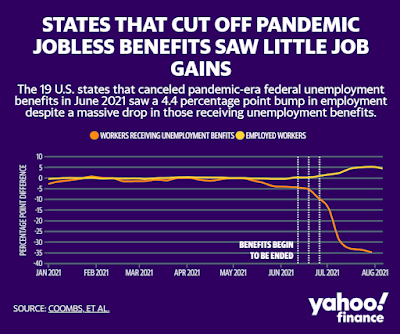
Childishly fallacious attempt to absolve enhanced
unemployment benefits from persistent jobless rates
The liberal media fail math again, trying to portray early ending of enhanced unemployment benefits as some sort of massive failure.

The reasoning? In states that closed the taps the media laments that over 33% of idle workers lost their benefits, but in return those states only saw a 4.4% gain in new jobs. 

Wow, only a 4.4% gain from a 33% cut, what a disaster. Just look at that graph! Who can't see this obvious failure of dogmatic free-market ideology?

Except that there are far more members of the labor force working than not, so they’re comparing a third of a very small number to 4.4% of a very large one.

Take a state like Colorado with a 6% unemployment rate. 6% of the workforce is idle and 94% of the workforce is employed.

So 2% (one-third of 6%) of the overall workforce lost extended benefits while 4.1% of the overall workforce saw new job gains (4.4% of 94%).

Or if we take an example using hard numbers, the Bureau of Labor Statistics says Colorado’s workforce consists of 3.2 million people, 3 million of whom were working in July and 194,000 of whom were filing for unemployment benefits.

https://www.bls.gov/eag/eag.co.htm

So if we apply these “disastrous” numbers…

33% of the 194,000 unemployed had their benefits cut or -64,000 people.

In return there was “only” a 4.4% increase in the 3 million people working or +132,000.

So in exchange for cutting extended benefits for 64,000 people, 132,000 people start working again.

Sounds more like a resounding success... for anyone who can do math (ie. not certain journalists).

ps. Except that Colorado is not one of the states cutting enhanced benefits early, which is why we haven't seen any single-month 132,000 job gains over there. In fact the number of people working in Colorado has actually fallen slightly since May: from 3,000,100 to 2,999,500 (see BLS tables).

Thursday, August 19, 2021

Minimum Wage Economics and Fallacies: Minimum Wage’s Biggest Fans, Part 1—White Racists, Xenophobes, Labor Unions, and Leftist Intellectuals

Click here to read the original Cautious Optimism Facebook post with comments

"[The minimum wage will] protect the white Australian’s standard of living from the invidious competition of the colored races, particularly of the Chinese.”

-Harvard Professor Arthur Holcombe (1912)

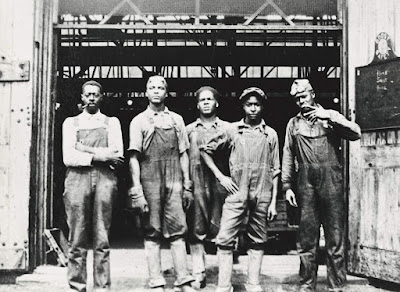
Countless black workers were deliberately and calculatingly 
 driven from their jobs by early 20th century minimum wage laws

7 MIN READ - The Cautious Optimism Correspondent for Economic Affairs and Other Egghead Stuff offers CO readers a short break from Afghanistan and Covid with a column on the racist origins of minimum wage laws.

Yes, you read that right. The roots of minimum wage laws lie with racism, unions, and left-wing academics blocking people of color and nonunion workers from getting good jobs going back to the early 20th century. And we’ve got the quotes to prove it.

PRICE THE COMPETITION OUT

In the 1910’s states such as Massachusetts, California, Arkansas, and others passed America’s first minimum wage laws. In the 1930’s President Franklin Roosevelt pushed for the first national minimum wage.

During the entire two-plus decades, white workers and unions across the country threw their political weight behind all these legislative efforts. Despite their public rhetoric championing the higher wage floor to help their laboring brothers and sisters, the truth is it was all a cynical attempt to price their nonwhite and nonunion competition out of the market.

The math behind this calculated effort is childishly simple so before looking at the historical evidence we’ll illustrate with a single example:

Take white, unionized shop worker A and black, nonunionized worker B in right-to-work state C.

A is more skilled, more productive and can make 4 widgets per hour, but he and his union colleagues demand $18 per hour.

B is less skilled and can only make 3 widgets per hour, but he only asks for $12 per hour.

So in an eight hour day A makes 32 widgets for $144 ($4.50 per widget) while B makes only 24 widgets for $96 ($4.00 per widget).

Even though our nonwhite worker isn't as productive (yet) as his white counterpart, he also asks for less money. Our employer calculates he can hire three employee A’s to make 96 widgets a day or four employee B’s to make exactly the same number, and operating in right-to-work state C (no "closed shops"), he opts for nonunion B employees who are more economical.

Union A workers could still be competitive if they asked for salaries more in line with their productivity (ie. $16 instead of $18), but historically unions haven't been keen to operate within the voluntary marketplace and looked instead to government to tilt the playing field in their favor.

They also worry that with some on-the-job training those minority nonunion workers might get better at the job, eventually match their productivity, and get pay raises even as they continue to economically outperform their white counterparts. 

Thus during the early 20th century white and unionized workers devoted a great deal of time and effort devising strategies to stop minorities and nonunion workers from getting those "foot in the door" starting jobs that might threaten their stranglehold over their respective trades.

The solution? Press the government to raise the minimum wage to $15 per hour.

The union wage remains unchanged at $18 since it’s still above the minimum wage, but the minority worker's wage is forced up from the previous $12 per hour to $15. 

The nonwhite worker's productivity hasn't increased, but thanks to the government the cost of hiring him has.

The cost of worker A remains $18 an hour for four widgets ($4.50 per widget) but now the cost of worker B is $15 an hour for three widgets ($5 per widget). 

Worker B is now no longer competitive.

Minimum wage therefore prices our nonwhite and nonunion workers right out of the factory which was the objective all along. 

Minority workers are then pushed out towards less desirable, lower paying jobs in agriculture, domestic work, or waiting tables—shut out of the blue collar factory workforce. The opportunity to work, learn new skills, raise their productivity and pay, earn a good living, and build a career is denied to them, proven by the “employment segregation” which was so common for at least the first half of the 20th century.

Unions claim this was never their strategy, but unions have also employed small armies of their own economists since the Progressive Era and the minimum wage analysis is a simple math problem that any high school student can solve. So yes, clearly the leadership knows what it’s doing even if the rank and file may not.

As economist Gary Wolfram recalls when acting as a Congressional Chief of Staff in the 1990’s, he was approached by labor union lobbyists pushing for another increase in the minimum wage. They were taken aback when he replied…

“Why are you guys here? None of your members make less than the minimum wage… …Well you’re here because you want to raise the price of a substitute… … to increase the price of a substitute for high skilled labor which is low skilled labor. And once I do that I’m going to substitute capital for labor and demand more high skilled labor and that’s why you’re here.”

During the early 20th century white Australian workers also used the same minimum wage strategy to price lower-wage Chinese workers out of the market, white Canadian workers used minimum wage to bar Japanese immigrants from their workplaces, American workers pushed hard for minimum wage to throw black workers out of their jobs, and white workers in apartheid South Africa did the same even in the late 20th century.

MEA CULPAS

In the 21st century most labor unions and racists won’t come out and openly admit their goal is to price their minority or nonunion competition out of work. Instead they and their paid economists wail that they “care about the living standards of their fellow workers” and are only expressing solidarity with laboring classes against exploitative businessmen everywhere. 

And feelgood liberals fall for the narrative hook, line, and sinker a la P.T. Barnum.

But white and union workers haven’t always been so discreet about their nefarious goals. 

Their motivations were much more openly expressed in the early 20th century as the introduction of minimum wage laws was being debated. Starting as early as the Progressive Era whites, unions, and academic eugenicists praised minimum wage's prospects for preventing the “inferior races” from earning a better living and thereby “breeding” and “increasing their numbers…”

1) Royal Meeker, Woodrow Wilson’s labor commissioner and a Princeton economist argued in 1910 that:

"It is much better to enact a minimum-wage law even if it deprives these unfortunates of work. Better that the state should support the inefficient wholly and prevent the multiplication of the breed than subsidize incompetence and unthrift, enabling them to bring forth more of their kind."

2) Harvard Professor Arthur Holcombe wrote approvingly of Australia’s proposed minimum wage as it would shut Chinese immigrants out of the labor market. Writing in 1912 Holcombe cheered:

“[The minimum wage will] protect the white Australian’s standard of living from the invidious competition of the colored races, particularly of the Chinese.”

3) A minimum wage was passed in British Columbia, Canada in 1925 for the same purpose: to shut Japanese immigrants out of the lumber labor market.

4) Progressive Columbia economist Henry Rogers Seager stated:

"The operation of the minimum wage requirement would merely extend the definition of defectives to embrace all individuals, who even after having received special training, remain incapable of adequate self-support…..If we are to maintain a race that is to be made up of capable, efficient and independent individuals and family groups we must courageously cut off lines of heredity that have been proved to be undesirable by isolation or sterilization . . . ."

5) University of Wisconsin economist John R. Commons wrote in his book “Races and Immigrants”:

“[Wage] competition has no respect for the superior races. The race with lowest necessities displaces others.”

6) And the late free-market economist Walter Williams documented the publicly affirmed minimum wage strategy of apartheid South African white unions as recently as 1989 in his book “South Africa’s War Against Capitalism.”

Williams writes:

“During South Africa's apartheid era, white unionists argued ‘in absence of statutory minimum wages, employers found it profitable to supplant highly trained (and usually highly paid) Europeans by less efficient but cheaper non-whites.’”

“One South African union leader said, ‘There is no job reservation left in the building industry, and in the circumstances I support the rate for the job (minimum wages) as the second best way of protecting our white artisans.’”

“The South African Nursing Association condemned low wages received by black nurses as unfair. Some nurses said they wouldn't accept wage increases until the wages of black nurses were raised…”

“…You can bet the farm that these calls for minimum wages for blacks didn't represent white compassion for the welfare of blacks. Minimum wages are simply one of the most effective tools in the arsenals of racists everywhere.”

(Correspondent’s note: the demands of white South African nurses that all wages be raised before their own echoes of modern-day corporations Amazon and Starbucks demanding a nationwide increase in minimum wage, a strategy we will cover in the next column)

So as woke “Fight for $15” and “living wage” advocates drone away to raise the minimum wage most have no idea they are realizing the dream of white supremacists and anti-immigrant xenophobes a century-over, even as they accuse minimum wage opponents of being the "racist” and “anti-immigrant" ones.

Even more strange is the entire progressive Left and mainstream media, who in the era of Trump and Biden leave no pebble unturned searching for any hint of racism real or imagined, have been completely silent on the adoption of a policy that was blatantly racist for most of the last century.

In fact minimum wage advocates and the press even portray the Fight-for-$15 as a "struggle against Jim Crow” and liken their cause to the civil rights movement, all while ignorant of their own agitation for precisely the instrument of discrimination that white racists embraced during the real Jim Crow era (CNN: “The Fight for $15 Takes on the Jim Crow Economy” and Time: “The Fight for $15 is our Selma”).

https://www.cnn.com/2018/04/13/us/fight-for-15-birmingham/index.html

https://time.com/5940311/minimum-wage-biden/

Well the strategy has worked, just as it worked a century ago.

Given that federally mandated wage floors have long been placed higher than the productivity (or what economists call Marginal Revenue Product) of swaths of unskilled minority workers it’s no surprise that black and Hispanic unemployment has consistently run several points higher than joblessness for whites going back nearly a century (see charts). 

The minimum wage dream of shutting minority labor out of the workforce has been realized by the progressive Left for a hundred years, and today they continue the fight to raise the bar even further.

(Federal Reserve charts: black and black youth historical unemployment rates)

https://fred.stlouisfed.org/series/LNS14000006

https://fred.stlouisfed.org/series/LNS14000018