Friday, July 24, 2020

Once Again the New York Times Proves it’s Clueless About the Gold Standard


8 MIN READ - The Cautious Optimism Correspondent for Economic Affairs and Other Egghead Stuff dispels yet another fallacious New York Times anti-gold standard column with factual historical corrections.


Federal Reserve Board of Governors nominee Judy Shelton

This week the Times ran yet another piece attacking Trump Federal Reserve Board of Governors nominee Judy Shelton, mostly aimed at her past statements supporting the dollar’s return to some form of gold standard.

Although Shelton has walked back her pro-gold stance to better her odds of confirmation, her revised position suggesting the Fed should follow some form of rules-based policy—akin to the well known Taylor Rule developed by Stanford economist John B. Taylor—has nevertheless drawn the ire of central bank apologists everywhere.

This time the paper has wheeled out former Obama administration Treasury official and SEC fraud lawsuit defendant Steven Rattner who predictably recycles the same fallacies and myths about gold that informed proponents of the gold standard have dispelled countless times before, and the Economics Correspondent does so again.

https://www.nytimes.com/2020/07/22/opinion/federal-reserve-judy-shelton.html

Rattner begins his anti-gold crusade by blaming it for the Great Depression:

1) “there’s the gold standard, a significant culprit in deepening the Great Depression and abandoned decades ago by every country in the world.”

Rattner leaves out that during the 1920’s and early 30’s the world was not operating under the genuine classical gold standard of the 1879-1914 period but rather a paper-gold hybrid “gold exchange standard” engineered by Great Britain.

This interwar pseudo-gold standard largely substituted central bank paper notes as “equal to gold” which allowed Europe in particular to print far more currency than it could ever possibly hope to convert from its finite gold reserves—a destabilizing inflation that the honest classical gold standard would never have permitted.

When recession struck in 1930 the result was a predictable deflation and suspension of gold convertibility since world central banks had circumvented the traditional discipline of gold and printed far more redemption promises than they could keep.

It is noteworthy that the USA was an exception, still operating on a purely gold coin standard but with an activist central bank. The Fed engineered its own QE inflation to help Britain with its chronic trade deficits in the late 1920’s and in doing so created the stock market and real estate bubbles of 1927-1929.

Furthermore, when the USA entered recession in 1929 a European-style deflation was not inevitable as the Fed still had plenty of gold to support the dollar (the U.S. held by far the largest gold reserves in the world at the time) but it chose to sit on its hands and do nothing as the money supply contracted back to its pre-1929 levels.

Even worse, as small unit banks began experiencing depositor runs across rural America, the Fed refused to carry out the very role it was created to perform: lender of last resort, providing short term loans to prevent liquidity failures just as larger banks had done in the pre-Fed era—a responsibility the Fed nationalized in 1914 and then neglected.

Far from gold being the culprit during the Great Depression, it was the “managed” gold standard of the Fed itself which overrode what normally would have been natural market adjustments to the economic downturn, an observation Milton Friedman won the Nobel Prize for.

Put more simply, had the world been on a genuine gold standard in the 1920’s and 1930’s instead of a paper-gold hybrid in Europe and the Fed suppressing the normal market movements of gold in America, there would never have been a Great Depression in the first place.

Or as George Mason University monetary economist Lawrence H. White has noted

“The interwar period shows us a case where central banks—not the gold standard—ran the show”

…and…

“Several authors identify genuine historical problems that they blame on the gold standard, when they should instead blame central banks for having contravened the gold standard.”

But of course Rattner leads his readers to blame “the gold standard” as primary culprit.

For a more detailed reading on the Fed’s role in starting and worsening the Great Depression, you can read the Economics Correspondent’s articles on 1920’s and 1930’s monetary policy at:

http://www.cautiouseconomics.com/2018/11/the-great-depression-01.html

http://www.cautiouseconomics.com/2018/11/the-great-depression-002.html

http://www.cautiouseconomics.com/2018/11/the-great-depression-03.html

http://www.cautiouseconomics.com/2019/01/the-great-depression-04a.html

http://www.cautiouseconomics.com/2019/02/the-great-depression-04b.html

http://www.cautiouseconomics.com/2019/02/the-great-depression-05a.html

http://www.cautiouseconomics.com/2019/03/the-great-depression-05b.html

2) Rattner then goes back to the late 19th century to blame the gold standard for repeated banking panics in the USA. The suggestion is that a return to gold means a return to more frequent financial crises.

“Between 1880 and 1933, the United States experienced at least five full-fledged banking crises"

The first problem with this “analysis” is that three of the “full-fledged banking crises” were during the Great Depression itself (1930, 1931, and 1933), a period of gross central bank malfeasance that we’ve already discussed. That leaves two bona fide crises under the more genuine classical gold standard: 1893 and 1907.

More importantly Rattner seems to be unaware that many other countries were on the gold standard at the same time but suffered no banking crises. Great Britain experienced one very brief, short panic in 1890 (The Barings Crisis) even with its problematic monopoly central bank, and Canada experienced none.

In fact Canada was on gold and had no central bank from 1817 until 1935, when the Bank of Canada was established, and in that 118 years experienced no banking panics at all. Even in the early 1930’s when 10,000 U.S. banks closed their doors for good, not a single bank failed in Canada even though the country was hurt at least as badly by the Great Depression.

The same story of stability is true for Scotland which from 1716 to 1845 (129 years) was on a gold or silver standard with no central bank and experienced not a single banking panic.

Over a century free of financial crises: the gold-based decentralized systems produced a far superior track record to Rattner’s vaunted Fed fiat era.

3) More on the 19th century. While it’s true the United States had the most unstable banking system in the industrialized world during the classical gold standard period, it wasn’t gold—as evidenced by the stable experiences of Canada, Scotland, Great Britain, and others—but rather America’s peculiar but deadly mix of horrendous bank regulations to blame.

During the 19th and early 20th centuries most American states restricted bank branching, forcing banks to operate as “unit banks” with only one office in one location. At the founding of the Fed in 1914, the U.S. had over 25,000 banks, but over 95% of them had no branches.

Unit banking was a scourge for most of America’s history as a tiny unit bank could not diversify its loan portfolios or even its depositors. A unit bank in a farming region, for example, was completely tied to the fate of the local crop or a local industry. So if the price of corn plummeted, most of the banks in the corn belt failed.

Also, small unit banks were highly dependent on a handful of local wealthy depositors. During an economic downturn if one large depositor withdrew his funds the bank could fail overnight.

There are other hugely destabilizing consequences to America’s perverse unit banking design, but it suffices to say Canada and Scotland allowed nationwide branch banking from their industries’ inceptions. And England dropped unit banking in the early 1800’s, a decision that contributed to greater stability in the latter half of the century.

When depressions hit countries with nationwide branch banking, no one or two hard hit industries or wealthy depositors could bring a bank down since it had such a wide range of nationwide loans and depositors to draw from.

Incidentally, unit banking was still law in over two-thirds of U.S. states during the Great Depression which explains why so many small banks failed. In states that at least allowed unrestricted branching within state lines (interstate branching was still completely illegal during this period) banking was much more stable. In California, for example, even though banks were temporarily ordered to close their doors during FDR’s bank holiday, not a single bank actually failed.

The 1880-1914 experience in the U.S. was made even more volatile by backwards Civil War era legislation known as the National Banking Acts. These laws, designed to finance a war, required banks to back any currency/notes they issued 110% by U.S. Treasury bonds. If banks didn’t hold U.S. bonds, they weren’t allowed to issue currency. And after the war as the federal government retired "greenback" notes, private banks were once again the nation’s primary source of paper currency (as was the case in Canada and Scotland).

When the Civil War ended, the government consistently paid down the national debt and Treasury bonds began to disappear. But the regulations remained, tying banks’ hands and making them unable to issue currency since the bonds they needed no longer existed. So during harvest seasons when farmers came to withdraw cash to pay their hired hands regulations prohibited banks from issuing cash.

Since most laborers had no checking accounts in those days farmers, needing something to pay their workers with, then demanded gold coins which resulted in a drain on reserves from the banking system—which in turn precipitated a contraction of credit and often times recession. Combined with the instability of unit banking, these perverse regulations often created full-blown banking panics including major ones in 1873, 1893, and 1907 along with smaller incipient crises in 1884, 1890, and 1900. It's no coincidence that most of the era's crises began in the autumn.

While banking panics raged in America, across the border the Canadian banking system—also on gold—continued to operate smoothly.

The demonstrative stability of the unregulated, decentralized, gold-standard systems of Canada and Scotland are even more impressive when considering all the contemporary crises that occurred in the USA and England. The instability of such large economies could easily have spread to their smaller neighbors to the north, but the Canadian and Scottish banking systems were so strong and diversified that they remained solvent throughout.

So Rattner deceives his readers when blaming gold for the U.S. banking panics of the 19th century. The true blame lies with lousy bank regulations.

4) Rattner then contrasts the post-gold standard era and boasts that the U.S. has experienced only two banking crises since:

“in the past 87 years, we’ve had two [panics].”

Rattner doesn’t mention the U.S. was still on the international gold standard from 1933-1973, nearly half of those 87 years. If correlation equals causation then he must give gold half the credit.

More importantly, knowledgeable economists understand that it was the introduction of federal deposit insurance in 1933 that mitigated bank runs afterwards, not delinking the dollar from gold. As Milton Friedman and Anna Schwartz pointed out in their classic 1963 book “A Monetary History of the United States”…

“Federal insurance of bank deposits was the most important structural change in the banking system to result from the 1933 panic, and, indeed in our view the structural change most conducive to monetary stability since state bank notes were taxed out of existence immediately after the Civil War.”

In fact delinking the dollar from gold domestically doesn’t even pass the common sense test. Of the two policies, which is more likely to prevent depositors from withdrawing their money in a panic: Telling them they can’t redeem their funds for gold coins? Or that their funds are safe and insured up to $250,000 by the federal government?

5) Rattner moves on from gold and criticizes Shelton’s modified view that the Fed should at least be disciplined by some set rules.

But his contention that “[Shelton’s] view that interest rates should be ‘rules based’ would have prevented the central bank’s emergency cuts” is simply false.

Rules based policies for central banks process inputs such as inflation, unemployment, and GDP growth and given a slow enough economy can guide policy to lower rates in response. In fact the Taylor Rule itself produced a policy recommendation of slightly negative interest rates for a brief period in early 2009, right after the financial crisis (see Taylor Rule chart).


While the Economics Correspondent is no fan of negative interest rates, it’s absurd to argue a regime that can guide the central bank towards a negative rate policy under emergency conditions “prevents” a central bank from making emergency rate cuts.

6) Finally Rattner decides to take a swipe at President Trump himself, accusing “Mr. Trump… [of] doing his best to politicize this remarkable institution.”

The criticism of Trump is unremarkable in that it’s completely expected for a paper that would attack Trump for curing cancer or solving cold fusion.

But what’s laughable is calling the Federal Reserve a “remarkable institution.” Since opening its doors the Federal Reserve has only started a dozen-plus recessions, turned its own recession in 1929 into the Great Depression, raised the price level by 2,500% since its inception, and presided over higher overall unemployment and slower economic growth during its 106-year tenure than in the 106 years that preceded it.

For a more detailed comparison of the Fed’s economic performance against the pre-Fed era, see George Selgin’s excellent analysis at:

https://www.youtube.com/watch?v=yLynuQebyUM#t=00m32s

Monday, July 6, 2020

Inflation and Deflation Fallacies Part 1: "An Overheating Economy Stokes Inflation"

Click here to read the original Cautious Optimism Facebook post with comments

5 MIN READ - The Cautious Optimism Correspondent for Economic Affairs and Other Egghead Stuff has already set an analysis of inflation in motion with his recent series on the Fed’s 2020 coronavirus easing programs. Hence the decision to strike while the iron is hot and continue with an examination of longstanding inflation fallacies.


In previous articles we’ve employed the century-old Equation of Exchange to establish the primary factors that raise prices: money supply, output, and velocity.

For those not familiar with the Equation of Exchange (mv = py), the Economics Correspondent recommends his April summary of the subject at:


British economist David Ricardo (1817) and American Irving Fisher (1911) asserted higher prices are induced by three factors:

-First and foremost, an increase in the money supply as measured by M1 or the broader aggregate of M2.

-Second, falling output or the same number of dollars chasing a declining quantity of goods and services.

-And third, rising velocity—a more rapid turnover of dollars spurred usually by more bank lending or a greater propensity to spend and reduced propensity to hoard by businesses and consumers.

However during a normal economic expansion, output doesn’t decline. It rises. So blaming inflation on higher economic output is a blind alley.

And during expansions it’s possible that economic actors may be more willing to spend and banks more willing to lend, but changes in velocity tend to be moderated during normal times. Velocity typically plunges only during economic crises, and only soars during hyperinflations when actors try to spend their money quickly before it loses purchasing power.

So during normal expansions, the culprit driving higher prices is nearly always an expansion of the money supply.

As the Economic Correspondent has previously written, the money supply has grown by leaps and bounds over the last four months, but the last four months have been anything but a normal expansion. Monetary velocity has contracted as is typical during a major crisis or recession.

So during more normal economic times, politicians and central bankers may try to blame rising prices on an “overheating economy,” or greedy businessmen, labor unions, the weather, a tight job market, “cost push” or “demand pull” inflation pressures, but the true source is nearly always the central bank and the commercial banks it influences through the manipulation of interest rates.

Hence, Milton Friedman’s famous quote from 1970:

“Inflation is always and everywhere a monetary phenomenon in the sense that it is and can be produced only by a more rapid increase in the quantity of money than in output.”

Let’s see how understanding the monetary roots of inflation during economic expansions helps deconstruct the many inflationary fallacies circulated by government officials, the press, and central bankers. Starting with…

I. “AN OVERHEATING ECONOMY”

This fallacy is repeated on a near daily basis in the press during periods of growth: “If the economy grows too rapidly inflation will spiral out of control.”

The contention is obviously thwarted by theory. The more rapidly y (output) grows, the faster p (prices) will fall—all other things being equal.

As the Equation of Exchange tells us, prices move inversely to output. So if an economy with a money supply of $100 produces 100 widgets each year—assuming consumers want to buy all 100 widgets—the average price of widgets will tend towards $1. However if the following year the economy produces 110 widgets but the money supply remains $100, the price of widgets will fall to 91 cents. ie. The same number of dollars chasing more goods and services.

But not only is the allegation of the “overheating economy” contradicted by monetary theory, American history is rich with evidence of the precise opposite. Although Americans of the last 90 years have only known rising prices, the pre-Great Depression era offers a century-plus empirical exhibit of rapid economic growth alongside *falling* prices.

The Golden Age of America’s economic history is widely considered the Gilded Age, roughly 1865-1914 or the half century from the end of the Civil War to the beginning of World War I (1914 coinciding incidentally with the establishment of the Federal Reserve). That fifty year period contains two of America’s greatest decades of economic growth and the United States emerged as the world’s largest economy in the 1880’s.

From 1866 to 1913 American real GDP rose 588% ($466 million to $3.21 billion, constant 1913 dollars—source: Johnson, Williamson) or at a compounded growth rate of 4.2% per year.

By contrast, in the 47 years leading up to 2019—which has included two pretty good decades: the 1980’s and the 1990’s—GDP has risen by 254% ($6.05 trillion to $21.4 trillion, constant 2019 dollars—source: BEA) or 2.7% per year.

Given that the U.S economy grew to seven times its size from 1866-1913 vs only 3.5 times its size from 1972-2019, one would expect the Gilded Age to be a period of runaway hyperinflation—if we listen to the business news, government policymakers, and liberal economists. After all, every time GDP growth touches 3% we’re warned that unless the Fed acts uncontrollable inflation is right around the corner, so a near half-century of 4.2% growth with no Fed must have been a hyperinflationary disaster, right?

Of course not. From 1866 to 1913 the purchasing power of the U.S. dollar actually rose, not fell, from $1 to $1.58.

Putting it another way prices fell by 32.5%. What had cost $1 in 1866 only cost 67.5 cents by 1913. The United States actually experienced a half-century *deflation* averaging about 0.9% per year.

The historical record is again consistent with the Equation of Exchange. Under the classical gold standard, and with no Fed to push monetary expansion to its limits, U.S. money supply growth was limited roughly to the pace of new gold mining discoveries plus the balance of international payments. But as the growth of goods and services outstripped the growth of money, y (output) outgrew m (money supply) and the result was gently falling prices.

That’s nearly fifty years of evidence debunking the presumption that “too much economic growth sparks inflation.”

In fact, the evidence goes back even further. If we measure economic growth and prices from 1800 to the eve of the creation of the Fed (113 years), American GDP grew 9,800% or 4.0% per year for over a century. Again, government officials and Fed economists would have us believe the entire 19th century must have been an economic quagmire of hyperinflation since the economy must have been “overheating” virtually the entire time.

Instead, the dollar gained 76% in value and what cost $1 in 1800 sold for only 58 cents in 1913.

The same trends can be seen throughout the Industrial Revolution and Second Industrial Revolution in Great Britain: rapidly rising output and living standards with gently falling prices as the expansion of gold or silver-based money was unable to keep pace with the growth in goods and services. The rest of Europe and Canada, effectively the entire industrialized world—reflect the same experience.

The only interruptions were periods when governments suspended the gold standard—usually wars such as the War of 1812, American Civil War, or the Napoleonic Wars. But when peacetime and the gold standard returned, prices resumed their decline and across the entire 150 year period from the dawn of the Industrial Revolution to World War I prices fell across the board.

It was only when central banks were established and particularly western governments ended the domestic gold standard (1931-1935) that the era of uninterrupted price inflation—that people are so used to today—began. Beginning in the depths of the Great Depression, central banks launched a deliberate policy of producing money faster than the real economy grows, thus driving prices relentlessly and permanently upwards. In a dramatic reversal of the price level, what cost $1 in 1933 costs a little over $20 today.

The regimen of consistent and neverending inflation—usually moderate, sometimes extreme, always needless—remains a staple of monetary policy today.

We’ll continue examining numerous other inflation fallacies in Part 2.

Sunday, June 21, 2020

Left Coast Correspondent: BLM Rioters Pull Down Statue of Abolitionist Ulysses Grant, the General Who Ended Slavery


The Cautious Optimism Correspondent for Left Coast Affairs and Other Inexplicable Phenomena learned in history class that Ulysses S. Grant commanded the armies that ended slavery in the American South.


The Emancipation Proclamation may have declared slavery over in America, but it was just a nonbinding piece of paper to the Confederacy until Grant made it the new reality.

Hence the toppling of his statue in San Francisco’s Golden Gate Park provides us another sample to refine IQ estimates within the militant woke crowd. So far we know for sure the average never exceeds the temperature on foggy San Francisco evenings.

https://thehill.com/homenews/state-watch/503685-protesters-tear-down-statues-of-union-general-ulysses-s-grant-national

The average might be even lower were it not for a handful of clever leftists who would point out Grant either bought or was given one slave in 1859 who he freed just a year or two later—right before the Civil War started. So surely owning one person for a year or two condemns Grant to the pantheon of evil bigots, right?

However former racist Klansmen like late West Virginia Senator Robert Byrd have been quickly forgiven for using the N-word repeatedly on national TV…

https://www.youtube.com/watch?v=PnO6ai0Ktro#t=01m13s

…or serving as a recruiter and Kleagle of the KKK because his friendly legislative efforts later “redeemed” him.

Same for “put y’all back in chains” Joe Biden who, despite having done nothing for minorities since telling radio personality Charlemagne da God “you ain’t black,” gets a pass and ardent support from the leftist movement to become the next POTUS.

https://www.youtube.com/watch?v=7xqodjauwT0

So if voting for and passing a few laws that channel more taxpayer money and help to minorities is enough to raise them to heralded do-gooder, is leading the armies that ended the institution of American slavery forever good enough to save a president's statue from destruction?

That would require more thinking than the self-righteous wokebots are capable of.

ps. The Grant statue story is hidden away on the San Francisco Chronicle's website, lost among at least 50 other tiny headlines at the very bottom of the homepage or the equivalent of a footnote on page B26.

Friday, June 12, 2020

Fed Coronavirus Policy Inflation Followup: CPI Falls for Third Consecutive Month

Click here to read the original Cautious Optimism Facebook post with comments

2 MIN READ - The Cautious Optimism Correspondent for Economic Affairs and Other Egghead Stuff delivers his previously promised update on the Federal Reserve’s unprecedented efforts to provide liquidity to financial markets and its predicted effects on inflation.


The Bureau of Labor Services reported yesterday that consumer prices actually *fell* for the third straight month.

Read story here:

https://www.cnbc.com/2020/06/10/us-consumer-price-index-may-2020.html


Now the Economics Correspondent is open to criticisms that official CPI calculations use flawed methodologies to determine the cost of housing, and that including or excluding the officially “volatile food and energy sectors” can alter the results. Although for the record food prices have recently risen while energy prices have plummeted while economists predict prices may finally start to rise next month reflecting the recent rebound in oil markets.

However the Correspondent’s larger point is that according to some, none of this was supposed to happen. Inflation was supposed to be roaring by now simply because the Federal Reserve began historic and aggressive efforts to create new money to counter the coronavirus slump in mid-March.

The Fed has succeeded in creating new money, and a lot of it.

Since that historic week in March the monetary base has increased 47% from $3.53 trillion to $5.199 trillion.

https://fred.stlouisfed.org/series/BOGMBASEW

Bank reserves have increased 89% from $1.72 trillion to $3.25 trillion.

https://fred.stlouisfed.org/series/RESBALNSW

The money supply as measured by M1 (currency + demand deposits) has risen 24% from $4.14 trillion to $5.10 trillion.

https://fred.stlouisfed.org/series/M1

And the broader money supply measured by M2 has risen 14.5% from $15.8 trillion to $18.1 trillion.

https://fred.stlouisfed.org/series/M2

These numbers are all incredible and many are unprecedented, eclipsing even the alarming gains during the 2008 financial crisis. And all of this in a major recession with output falling.

So with far more money chasing even fewer goods and services, why isn’t inflation roaring? Shouldn't the U.S. be one step shy of Venezuela by now?

More money and falling output are indeed a formula for inflation, but they aren’t the only factors that influence prices. And as the Correspondent wrote in April, falling velocity might very likely offset inflationary factors—lower velocity being the product of millions losing their jobs, income, and spending power, and firms hoarding cash as a reserve instead of spending on huge investment projects during uncertain times.

Based on the scale of the Fed’s open market operations, the Economic Correspondent believed in March and April that the Board of Governors was already anticipating plummeting velocity in ensuing months, and so far they’ve been proven right. In fact, had the Fed not engaged in such aggressive monetary operations the U.S. could already be in a severe deflationary environment by now—severe meaning not a benign -0.5% or -1.0% annualized drop in prices but something much more rapid like -5% or even closer to -10% such as during the Great Depression.

And there has been one more, unmeasured factor subduing inflation: new money has spilled over into the stock market and created “asset inflation” which is not measured in the CPI index because consumers aren’t concerned with the price of the S&P 500 Index when paying their daily living expenses.

The Economic Correspondent has never been a big fan of the Federal Reserve or monopoly central banks in general, but so far on the inflation question the Fed has been right.

What inflationary prospects lie further down the road—in the medium or long terms—will be a speculative subject of discussion in a future column.

To learn more about the importance of the money supply, GDP, and velocity’s impact on consumer prices you can go back to Parts 4 and 5 of the Correspondent’s series on coronavirus monetary policy at:

http://www.cautiouseconomics.com/2020/04/monetary-policy-11.html

http://www.cautiouseconomics.com/2020/04/monetary-policy-12.html

Also for a primer on open market operations and the Fed's tools for controlling the money supply, as well as the Fed’s domestic and international rationales for its aggressive securities purchase programs beginning in mid-March, Parts 1-3 of the same series are at:

http://www.cautiouseconomics.com/2020/04/monetary-policy-08.html

http://www.cautiouseconomics.com/2020/04/monetary-policy-09.html

http://www.cautiouseconomics.com/2020/04/monetary-policy-10.html

Wednesday, June 3, 2020

Paul Krugman: Surprisingly "Upbeat" and Modest About a Post-Covid Recovery

Click here to read the original Cautious Optimism Facebook post with comments

5 MIN READ - New York Times columnist Paul Krugman is “upbeat” about the prospects for a post-Covid economy. Which means the Cautious Optimism Correspondent for Economic Affairs and Other Egghead Stuff is now officially worried.


OK in all seriousness, Krugman has given us something rarer than an objective reporter at MSNBC: an interesting interview which is almost as big a surprise to us as the post-2016 election stock market was to him. But in all fairness there’s a very un-Krugmanesque humility on his part regarding the novelty of the 2020 sudden full-stop depression.

(Interview at:)

https://www.bloomberg.com/opinion/articles/2020-05-27/paul-krugman-is-pretty-upbeat-about-coronavirus-economic-recovery


So Krugman might not win another Nobel Prize for disproving the broken clock theory after all.

However, in case anyone thinks the Economics Correspondent has gotten soft and joined the Legion of Krug there’s always the recovery, a phase where the Nobel Laureate will be tempted to fall right back into his Keynesian “stimulus” groove which we’ll discuss at the end of this column.


First the good and not-so-bad:

1) PK: “Is this a demand shock or a supply shock? Yes. And no. The aggregate-demand-aggregate-supply framework doesn't work well for this crisis.”

“What's happening now is that we've shut down both supply and demand for part of the economy because we think high-contact activities spread the coronavirus. This means we can't just use standard macro models off the shelf.”

So the Economics Correspondent agrees with this. For many sectors both the supply and demand curves have quickly gone “inelastic” and nearly vertical. On the demand side it doesn’t matter how low prices fall—for airline tickets or cruise lines or movie theaters, for example—because people are simply not going to buy many things at pre-Covid levels. 

Even those who are willing are often being prohibited by government social distancing restrictions, but absent those ordinances demand in most sectors will still be down considerably from 2019.

Likewise on the supply side it doesn’t matter how much people are willing to pay to go to a sporting event or a concert. The suppliers are simply not going to make more of their product available. Even when paying for in-person college classes or fitness clubs, schools and firms are going to severely limit supply to a fraction of original capacity, also either voluntarily or by government decree.

And the “can’t use standard macro models” comment reflects a rare little bit of humility from Krugman that this recession is unique in a way we’ve never seen before, and that it’s hard to return to one's favorite playbook that’s been used over and over before. It’s a very, very rare dose of modesty from Krugman who typically claims to know more than everything.

So don’t let it be said the Economics Correspondent doesn’t give credit where it’s due—even when it goes to an incurably wrong polemicist like Krugman.

2) PK: “The fall in demand isn't just households postponing consumption until they can go to restaurants again; it's also a crash in construction of houses, commercial real estate and so on. Who wants to build an office park in a plague?”

Krugman is referring to investment demand as well as consumer demand and he has a valid point here. That demand curve for major capital investment spending has temporarily steepened as firms are more interested in preserving cash to ride out an uncertain future than risking lots of money on a new investment projects.

3) PK: “My take is that the Covid slump is more like 1979-82 than 2007-09: it wasn’t caused by imbalances that will take years to correct. So that would suggest fast recovery once the virus is contained... …All that said, right now I don’t see the case for a multiyear depression. People expecting this slump to look like the last one seem to me to be fighting the last war.”

This is not a unique take, but it’s probably correct. Although it would be foolish to say there were absolutely no bad investments or economic imbalances in February 2020, the reality is there wasn't one giant sector whose economics were completely out of whack such as commercial real estate and the S&L’s that financed them in the late 1980’s, dot-com companies in the late 1990’s, or residential housing and the banks/mortgage companies that were partially compelled to finance them in the mid-2000’s.

However the Economics Correspondent would warn that the longer the virus goes unresolved, the longer the recovery will take since more and more households, firms, and financial institutions will experience losses that take longer to recoup, leading us to…

4) PK: “Another is that even if we didn’t have big imbalances before, the slump may be creating them now. Think of business closures, which will require time to reverse.”

Again, this is the moderate risk to recovery. The longer the negative effects of lockdowns, or partial-reopenings, or even the virus’ effect on voluntary consumer behavior, the more business that fail—typically small and medium sized although we have seen a few high profile large bankruptcies already such as Hertz, Neiman Marcus, JC Penney, and several energy firms that were already on the margin. And it will take time for the liquidated failures to either restart or more likely be replaced by some new entrepreneur who fills the gap left behind.

5) PK: “In particular, we know enough to understand why conventional responses like stimulus or tax cuts are inappropriate…”

Krugman surprises here recommending restraint on higher inflation and stimulus spending (gasp!), his favorite go-to Swiss army knife for all economic problems, but he also predictably dismisses tax cuts.

While tax cuts are a question of degree of economic benefit, and government stimulus spending is a question of degree of harm (or more specifically, postponing a recovery), the crisis phase is likely one where tax cuts aren’t going to have as positive an effect as usual. 

Again, a marginally higher incentive to invest isn't going to inspire many firms that are reluctant to risk large sums of investment capital while the future is so uncertain. Their focus is maintaining cash reserves to get to the end of the crisis.

Which leads me to where I think Krugman will drop the Doctor Jekyll routine and revert to Mister Hyde: during the recovery.

6) Will Krugman continue to be halfway reasonable when the crisis is resolved and America starts picking up the economic pieces and rebuilding? 

Don’t bet on it.

The Economics Correspondent has read Krugman for almost twenty years. Based on his writings, speeches, lectures and general ideology here is a back of the napkin prediction for Krugman’s policy stance in a year or two:

Once the virus itself is contained, if the economy shows even the slightest iota of sluggishness during recovery—that is, it doesn’t return to full employment within two quarters—Krugman will drop the “standard models don’t work in this new environment” humility and go right back to the Keynesian stimulus playbook.

Because joblessness might be 15% or 10% or 8% we will need to hasten recovery with aggressive government action, he will say. And it’s all the evil GOP’s fault for stubbornly refusing to borrow and spend another $2 trillion here or $3 trillion there or $4 trillion anywhere on a giant stimulus package. 

And even though firms will be in more of a risktaking mood once recovery is underway, Krugman will argue anyone who calls for tax cuts or deregulation to encourage more investment is just another free market/conservative neanderthal who doesn’t understand Macroeconomics 101 (ie. New Keynesian economics).

He may even call for the nationalization of healthcare as a “stimulus,” or a government “investment bank” as Keynes urged during the Great Depression, or something akin to the Green New Deal. And it will all come in lockstep with calls for tax hikes on businesses, investors, and the wealthy.

If Trump is still president he may find some common ground on a giant infrastructure spending package.

Because when the crisis has bottomed out and the upward recovery slope kicks in, Krugman will likely  toe the Keynesian “in the short run” line yet again, transforming back into the hammer that sees everything as a nail.

If Krugman surprises and doesn’t revert straight back to his personal obnoxious brand of New Keynesian orthodoxy then the Economics Correspondent will, in very un-Krugmanlike fashion, be the first to admit error. In fact it will be a pleasant mea culpa to see him remain civil and reasonable more than a few days. On the other hand I’ve also never seen a rattlesnake permanently forswear biting either.

Monday, May 18, 2020

Left Coast Correspondent: Chinese Propagation of Coronavirus to Globe Through International Flights Likely a Deliberate Calculation

 Click here to read the original Cautious Optimism Facebook post with comments

2 MIN READ - The Cautious Optimism Correspondent for Left Coast Affairs and Other Inexplicable Phenomena offers a yet-unproven but highly viable theory to explain why the Chinese Communist Party allowed unrestricted international flights to leave Wuhan even as travel within China was locked down to contain the domestic spread of the Wuhan coronavirus:

General Jack Keane (ret.)

"Post-pandemic, there needs to be a comprehensive strategy in dealing with [what] China has done… …actually growing a pandemic from an epidemic by permitting international flights out of the country," [Chairman of the Institute for the Study of War Jack] Keane said.”

“The retired general theorized that China allowed the virus to spread because Chinese President Xi Jinping wanted to neutralize the advantage other countries could have gained while China struggled with the outbreak.”

“He doesn't care about loss of life. He cares about the economic contraction that was experienced in his country. And he wanted the other countries to go through that same economic contraction as he was going through," Keane said. "And he was hoping that he would recover sooner than they did. That's what this is about. And he's got to be held accountable for that."

Read full story at:

https://www.foxnews.com/media/gen-jack-keane-china-criminal-behavior-coronavirus

(Left Coast Correspondent’s comment) While no evidence is available to the outside that Xi Jinping and the Chinese Communist Party leadership calculated to deliberately allow the virus to spread across the globe and place the rest of the world at the same economic disadvantage China was experiencing, such a sinister decision would be perfectly consistent with Beijing’s inexplicable and contradictory domestic and international "containment" policies.

Within the first few weeks or even days of Wuhan’s lockdown it’s impossible for the CCP leadership not to have realized its epidemic controls would inflict immense damage on their economy. They also would have quickly realized the virus and the economic consequences of fighting it might stay with them for a long time, perhaps years. China’s own scientists and economists aren’t stupid and it would be naive to think they didn't put two and two together very early.

Therefore, knowing that the Chinese economy was “going down,” Keane theorizes Beijing made a calculated decision that “If our economy is going down, we’re going to make sure the rest of the world goes down with us so that we maintain our number two position in the world.” A regime determined to level the playing field by dragging everyone down to their disadvantaged level, no matter how low the playing field would go, would have done exactly what China did.

Sunday, May 10, 2020

Analysis: Generations of Keynesian Policies Have Made Us Extremely Vulnerable to the Covid-19 Economic Crisis

Click here to read the original Cautious Optimism Facebook post with comments

4 MIN READ - The Cautious Optimism Correspondent for Economic Affairs and Other Egghead Stuff was particularly impressed by this article’s thesis (“an economy starved of savings has little resilience to any shock”), but more for its financial insights than its traditional Austrian capital insights which he’d like to criticize oh so slightly.


Read FEE.org article here:

https://fee.org/articles/generations-of-keynesian-policies-have-made-us-extremely-vulnerable-to-the-covid-19-economic-crisis


For those not familiar with Austrian Business Cycle Theory (ABCT), the act of saving one’s income—which means deferring consumption—preserves a share of the real physical economy to be channeled towards producing capital tools and machines that enable greater production and higher standards of living in the future.

The article opens with the first of two major insights by establishing that when consumers spend all their income and more, they are signaling to businesses to focus more on producing goods for immediate consumption and less on producing capital goods that increase output per worker in the future. And over time sustained overconsumption leads to slowing economic growth as “seed corn is eaten.”

ABCT also argues that when central banks force interest rates down, they discourage saving and encourage more borrowing and consumption. Thus fewer capital goods are produced and the artificially low interest rate actually slows economic growth over any time frame beyond the short-term cheap money “sugar rush.”

There are more nuances to ABCT but the Economics Correspondent will stop there and say he generally agrees with the theory.

However the key economic disruption in the coronavirus economic crisis is not insufficient capital goods leading to meager gains in productivity.

Even if factories were flush with more modern capital tools and machines, the economy would still be in the hole now because government lockdowns and the virus itself are interfering with the ability of human workers to cooperate and employ those machines efficiently—not to mention managerial planning, maintenance of capital machines, distribution of intermediate and final goods and services, and the ability of end consumers to purchase them or take delivery.

Which leads to the second and stronger insight of the article regarding the Federal Reserve’s policy impact on the economy’s financial health.

It’s no secret that nearly a decade of zero interest rates has encouraged debt, debt, and more debt—taken on by firms, households, and governments.

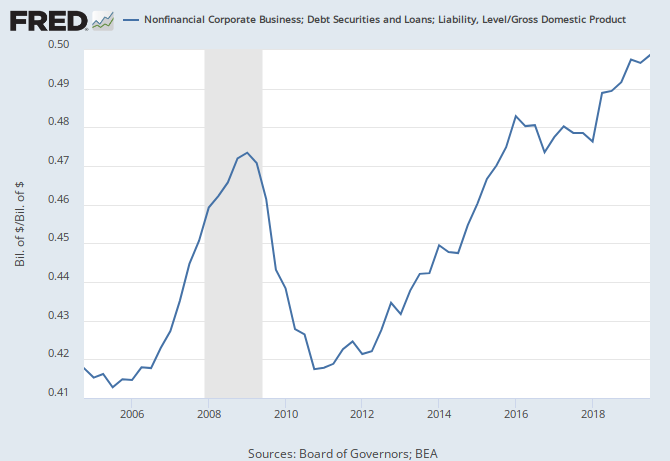
Companies have leveraged to the hilt, floating huge debt offerings not only to finance expansion, but also to buy back stock.

https://fred.stlouisfed.org/graph/fredgraph.png?g=qVLI

While the Economics Correspondent has no objection to share buybacks per se, the zero interest rate environment has incited more financially irrational buyback schemes.

For example, paying a cheap 3.5% on corporate notes to raise cash to buy back shares that pay dividend yields of 4% might seem like a perfectly logical move to a CFO except that debt markets would never buy the notes at 3.5% to begin with were it not for Fed interest rate manipulation. Hence the unnatural math has spurred higher risk and higher corporate debt loads.

Borrowing to buy back shares also deprives firms of financial flexibility during a slump. When the music stops suddenly—as it has now—a company can suspend those dividend payments to preserve cash, but it can’t stop paying interest on the debt or refuse to repay it which would lead to bankruptcy.

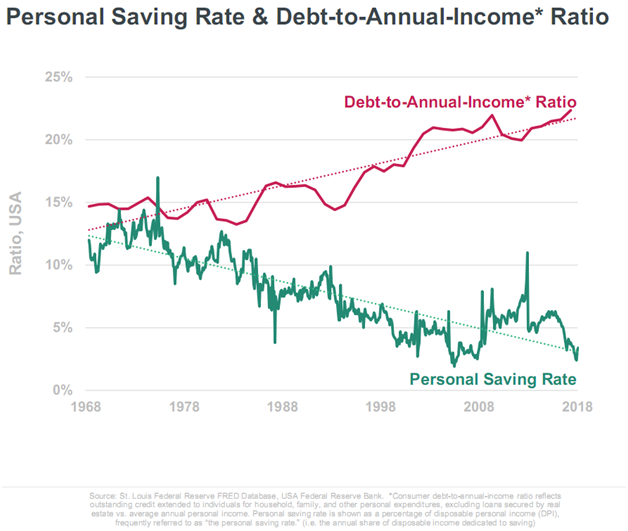
Households have racked up record debt since 2008 as well. Although household debt as a percent of GDP is slightly lower than in 2008, household debt as a percent of household income is once again at a record. And just as importantly the gap between household debt and personal savings has never been greater.

https://www.bourbonfm.com/sites/default/files/users/PatrickBourbon/Personal%20Saving%20Rate%20%26%20Debt-to-Annual-Income%20Ratio.png

And of course there’s the government’s highly publicized national debt and debt-to-GDP ratio. After rising rapidly from 2009, the debt-to-GDP ratio stabilized somewhat in 2014 around 100% and has set new peacetime records slowly ever since, but that stabilization is about to change very soon for the worse.

https://fred.stlouisfed.org/series/GFDEGDQ188S

The Economics Correspondent predicts the national debt will very soon eclipse the all-time record debt-to-GDP ratio of 120% set during World War II.

All of these record levels of debt and low savings are the result of a central bank that forced interest rates to or near zero for over a decade. With such low rates the public would be crazy not to borrow and consume, and just as crazy to save—except for the highly disciplined few willing to stomach paltry returns and save anyway.

Which brings us to the crisis. Suddenly firms, households, and governments don’t see much income coming in. We’ve all been forced to hunker down and, even when that ends, will mostly still keep hunkering down voluntarily until the virus problem is unequivocally resolved.

A society that had accumulated ample savings—both corporate and household—would have a cushion to ride out the storm. It would be painful, but it wouldn’t have to be desperate, at least in the short-term.

But thanks to the Fed few firms and households found themselves in that favorable position in March when the crisis erupted.

The result is companies are scrambling to borrow even more to build that cash cushion (with the Fed accommodating them yet again), many that were previously overleveraged are going bankrupt, and households and small businesses—which unlike corporations have few capital assets to pledge as collateral—are left dependent on unemployment checks and government assistance since they have little savings to get through the slump.

Even the federal government doesn’t have the money and has to borrow to, among other things, bail out highly indebted state governments.

And why didn’t they have a cushion? Keynesian economic policies.

Central banks believed before and after the 2008 crisis that economic recoveries should be “stimulated” with record low interest rates that ultimately produced record levels of indebtedness. Ironically the Austrian criticism argues that super low interest rates lead to slower growth and slower recoveries over the longer term because the economy is starved of savings and deprived of real physical capital.

And the attached FEE article is dead on right that America’s companies, households, federal and especially state and local governments are in a far more desperate financial position now because of the Keynesian monetary policies of yesterday.