Saturday, November 6, 2021

Local San Francisco News Profiles Million-Dollar Condos Besieged by Homeless Drug Addicts

Click here to read the original Cautious Optimism Facebook post with comments

Coincident with the Cautious Optimism Correspondent for Economic Affairs and Other Egghead Stuff's recent columns on San Francisco's homeless problem and recent building of housing units in the Van Ness corridor (after a near 30-year ban on new construction), the local news station just ran this story on, well.... both.

Take out four minutes if you want fresh images of just how bad the drug-addicted homeless have gotten squatting around million-dollar condominiums.

(KPIX-TV story: "San Francisco Luxury Condo Overlooks City's Worst Squalor")


And both sides of this twisted equation stem directly from policies supported by San Francisco voters for nearly four decades. For those who missed it, details at:

https://www.facebook.com/CautiousOptimism63/posts/1786507518226073

https://www.facebook.com/CautiousOptimism63/photos/a.492853127591525/1790203744523117

But not to worry, your trusty Economics Correspondent lives among the rich elite near Presidio Heights and Pacific Heights where limousine liberals like Julia Roberts have zero tolerance for the presence of the homeless. That's for the hoi polloi who live in only one million dollar units to deal with.

ps. In the YouTube version of this video one smart commenter asked: "You think that colorful haired gal voted for Trump or Biden?"

Friday, November 5, 2021

How the Hell Can You Stand to Live in San Francisco? Part 2

Click here to read the original Cautious Optimism Facebook post with comments

8 MIN READ - The Cautious Optimism Correspondent for Economic Affairs and Other Egghead Stuff continues explaining how he can actually suck it up and tolerate living in the workers paradise: the People’s Republic of San Francisco—this time devoting an entire column to San Francisco’s housing crisis.

In Part 1 I explained how certain backwards San Francisco policies are making problems like homelessness, syringes, human poop, shoplifting, store closures, car breakins, and business/job departures worse, and how as Economics Correspondent I’m lucky enough to be mostly unaffected by these policies. That’s at:

http://www.cautiouseconomics.com/2021/11/short-bites-18.html

Part 2 will be dedicated exclusively to San Francisco’s three-plus decade long housing crisis where home and rental prices have relentlessly spiraled out of reach for a greater and greater share of residents… most of whom still keep voting for the same policies.

HOW IT STARTED

First let’s review how San Francisco housing became a disaster to start with.

The City is already pretty small, surrounded on three sides by water, and is already a hotly desired living area due to its natural beauty and other urban amenities. So San Francisco housing prices have traditionally been higher than the rest of the country.

However in the 1980’s the increasingly progressive politicians and voters decided it would be best to prohibit building virtually all new housing. The one exception was a small enclave east of the South of Market District (SOMA) but that supply venue was so small it did nothing to offset what was effectively a citywide ban on new construction.

The forces behind the ban were a strange-bedfellows alliance of interest groups.

1) Standard liberal voters who considered it evil that developers can make a profit building houses so best to stop homebuilding altogether.

2) Homeless advocates who decided “If you’re not going to give new housing away for free to the homeless then we’ll make sure no one else can have it either.”

3) Conservationists who didn’t want to see anything that looked like a modern structure built anywhere in the City.

4) Wealthy high rise or hillside residents who paid for stunning views and didn’t want to chance another building going up beside theirs and blocking their scenery. In fact, city ordinance has long prohibited hotels in the Fisherman’s Wharf tourist area from exceeding five floors so as not to disturb the views for wealthy residents up on Russian Hill overlooking the Bay.

5) Homeowners in general who liked the idea of blocking new construction which effectively cartelized the supply of existing housing and drove their home values up faster.

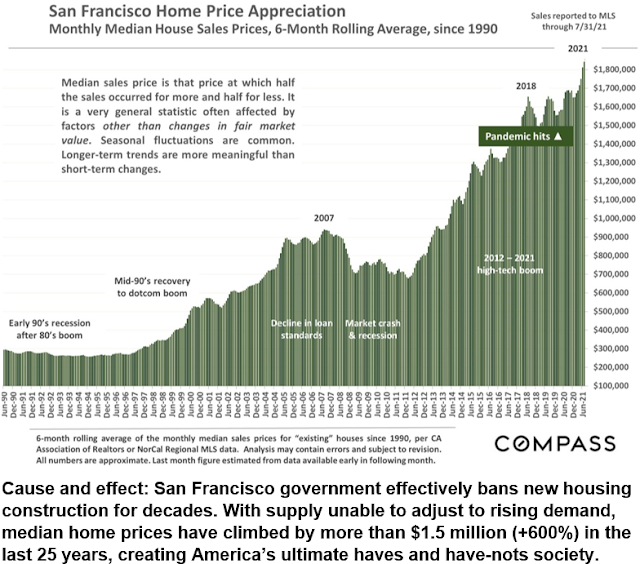
Well standard freshman microeconomics informs us when government freezes the supply of housing—making it “inelastic” as economists say—and the demand for housing rises due to population growth, inflation, lower interest rates, and increasingly wealthy international buyers, prices for both purchase and lease will skyrocket.

And they have. Today San Francisco’s median home price has reached $1.85 million, a sevenfold increase over 25 years.

Today only a tiny minority of the wealthiest can afford home ownership with the masses condemned to eternal renting.

With such a small minority of wealthy citizens owning an asset that continues to rise rapidly in value and everyone else shut out, San Francisco has become a shining example of haves and have-nots, a pejorative that the local liberals love pinning on free market conservatives. Yet despite all their virtue-signaling about the Republican evils of inequality, San Francisco’s progressive voters and government have created a societal GINI inequality coefficient higher than Nicaragua, Sudan, Congo, and Cameroon.

Another irony is San Francisco liberals routinely accuse conservatives who oppose high taxes and wealth redistribution of having an “I’ve got mine, now F-you” attitude.

Free market conservatives of course really think “I earned mine. Now you earn yours instead of using government to steal from me.”

But the great irony is that “I’ve got mine, now F-you” is precisely how San Francisco homeowners operate. Once they navigate into home ownership they lobby government to block any more homes from being built which is truly shutting out the underprivileged and telling them to screw off.

Or as Dennis Miller likes to say: “A developer is someone who wants to build a house in San Francisco. An environmentalist is someone who has a house in San Francisco.”

LIBERALS BLAME CAPITALISM

For nearly four decades as San Francisco voters and city government have refused to allow new housing construction, they’ve all universally condemned rising prices—except for existing homeowners who love it.

I remember a developer who actually penetrated pretty far into the obstruction process back in the mid 2000’s. The city government had placed an unrealistic barrier of “X-percent of all units must be sold at below market price” (I can’t remember the exact number, it may have been around 15 or 20 percent) which had effectively deterred new developers while giving the Board of Supervisors culpable deniability, arguing “Of course we allow new housing. We only require developers to meet their obligations to society's underprivileged.”

Well when that developer unexpectedly agreed to the terms the Board of Supervisors was caught off guard and quickly scrambled to raise the requirement at the 11th hour. Once again I can’t remember the exact number but it was something dramatic, akin to doubling the percentage of units that had to be sold at “below market.”

The developer, who had already sacrificed plenty to get permission to build in the City, balked at what was now a moneyloser and walked away. The Board of Supervisors cheered and high-fived, San Francisco liberals declared victory, and both went back the next day to complaining about high housing prices.

I've seen multiple ballot proposals to approve new housing construction projects in the City over the years and virtually all of them have been killed by the voters.

Another side-effect of BANANA policies (Build Absolutely Nothing Anywhere Near Anyone) is gentrification.

As prices skyrocket all over the city buying homes in once unthinkable poorer neighborhoods becomes an only remaining option for higher-income workers. But once they start buying prices are driven up to a level that the poor can no longer afford. Gradually higher income (ie. usually white and Asian) residents move in, displace the old guard, and the newly arrived money leads to a once dilapidated neighborhood getting a revitalized upgrade.

But inevitably the ethnic “diversity” of the neighborhood is watered down and liberals protest that “San Francisco is becoming a whites-only city.”

The next step then is to blame racism—in the most left-wing, progressive city in America—when in fact a ten-year old can see gentrification is the inevitable “pro-white” economic consequence of their own interventionist, anti-development policies.

All throughout I’ve been amused by the online commenters who then blame “free market capitalism” and “corporate greed” for skyrocketing home prices and all these other outcomes.

We’re talking about the most heavily government-controlled housing market of any large city in the United States, and a city government blocking virtually all attempts to build new houses—while sanctimoniously declaring “housing is a human right”—somehow serving as an exemplar of free market capitalism. It's akin to calling Joseph Stalin’s gulag archipelago labor camps “the logical outcome of the Soviet free market system.”

When confronted with the objection that artificially constrained supply is what’s driving unaffordability, not imaginary free-market capitalism, the locals often drum up a standard next excuse: “Well there’s no land left to build on anyway.”

Aside from the fact that San Francisco still has plenty of empty lots, abandoned buildings, and other plots available for sale to rebuild on, there’s also the option to “build up,” an idea that former Mayor Gavin Newsom made a half-hearted attempt to champion, but he was repeatedly squashed by the always-more-leftist Board of Supervisors.

To which the lefties then object “But we want San Francisco to stay charming. We don’t want to look like Hong Kong or Blade Runner.”

OK, I understand that sentiment although I don’t think it gives anyone the right to stop someone from building a house in the middle of an affordability crisis.

But even if you accept the “government should block new housing to keep San Francisco charming” premise, then why do they still 1) complain about rising home prices which they've created, and 2) blame "capitalism?"

Part of being an adult means accepting the consequences of your actions and admitting responsibility, a concept that’s pretty much been lost here for at least half a century.

On a positive note, a few years ago former Mayor Ed Lee did manage to outmaneuver the Board of Supervisors and get some limited new construction approved during his tenure. And in the last few years I’ve seen some new, larger scale construction go up near the Van Ness corridor and around Twitter headquarters.

Ed Lee died unexpectedly of a heart attack one night shopping at Safeway but his successor, current Mayor London Breed, has promised to continue his policies.

But San Francisco is more than 30 years and over 300,000 housing units behind the curve. The rate of new construction is barely enough to keep up with new demand, let alone make up for over three decades of inaction. So my personal prediction is prices will continue to rise—albeit not as rapidly as before—and the local lefties will exclaim “Aha! You see? They’re building new housing and prices are still rising. Government was never the problem!” (eye roll)

HOME OWNERSHIP: OK, NEVER REALLY AFFECTED ME

So how does this disaster not affect me personally?

Even when I moved to San Francisco home prices were already out of reach so I arrived expecting to be one of the City’s many “lifetime renters.”

And even if you’re rich enough to make the down payment and qualify for the mortgage on a median priced home ($1.85 million) there are still lots of other problems.

With such a huge mortgage to pay—$12,250 a month PITI on a median priced home with 10% down and a 3.5% 30-year loan—all it takes is one untimely job loss to put homeowners in desperate straits.

It’s one thing to keep paying a $3,000 mortgage while the government pays you $2,000 a month in unemployment. $12,250 is another matter entirely that can bankrupt anyone in a matter of months unless they have a lot of savings available to burn through.

The property taxes are still high. Yes, Proposition 13 capped the annual tax rate at 1.2% back in the 1970’s, but on a $1.85 million home that’s still $22,200 in annual property taxes alone.

San Franciscans love to take out their frustrations by looking for things wrong with conservative Texas and criticize the Lone Star State for its roughly 2.8% property tax rate (they fail to mention there's zero income tax in Texas), but the same $1.85 million home might cost $350,000 in Houston… and a 2.8% property tax on a $350,000 home is $9,800—a lot less than $22,200 in San Francisco.

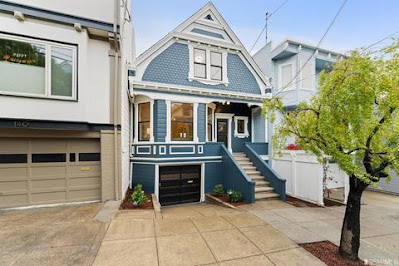
BTW in my district $1.85 million will get you three or four bedrooms and anywhere from 1,800 to 2,200 square feet. You’ll either get one floor of a "tenancy-in-common" (aka. TIC) building or your own tiny house directly attached at the sides to others (see photo).


Then there’s earthquake insurance. No private insurers are willing to take that risk on their own since a catastrophic quake that destroys the entire Bay Area would bankrupt them. So mortgagees mostly buy earthquake insurance from the California Earthquake Authority (CEA), a state agency. Although the CEA is funded by a consortium of private insurers, the funds and policies are managed by the state office.

Now I’ve never had to buy a CEA policy, but they’re famous for being incredibly expensive with as basic coverage as you can get on fairly lousy terms—but still required by many mortgage investors.

And if such a megaquake ever really struck there’s a huge question mark hanging over whether the CEA would actually be able to pay out, how long it would take, and how slow the catastrophe response and claims payout would be.

Perhaps we have some California homeowners here in CO Nation who live in earthquake zones who can provide more details on how their CEA policy works.

Also San Francisco homes tend to be very, very old—many over 100 years old. My own building was constructed in 1912.

While this makes for interesting architecture and beautiful neighborhoods—after the human poop and syringes are powerwashed away—you can imagine the cost of upkeep and repair for so much outdated/ancient plumbing, electrical systems, heating, construction… you name it.

So there’s lots of reasons not to stretch yourself too thin to buy a house in San Francisco. Unless you’re truly megawealthy with millions of dollars in the bank and can afford to be nickeled-and-dimed to death—with $5,000 and $10,000 nickels and dimes.

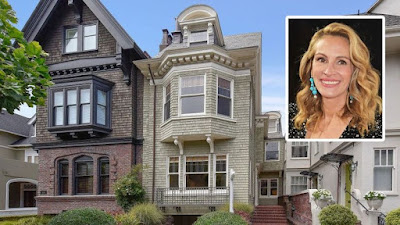
ps. Speaking of needing megawealth I've learned that Julia Roberts recently dropped $8.3 million for a Presidio Heights home about nine blocks from my apartment. See photo:

Monday, November 1, 2021

How the Hell Can You Stand to Live in San Francisco? Part 1

Click here to read the original Cautious Optimism Facebook post with comments

7 MIN READ - A new mini-series from the Cautious Optimism Correspondent for Economic Affairs and Other Egghead Stuff.

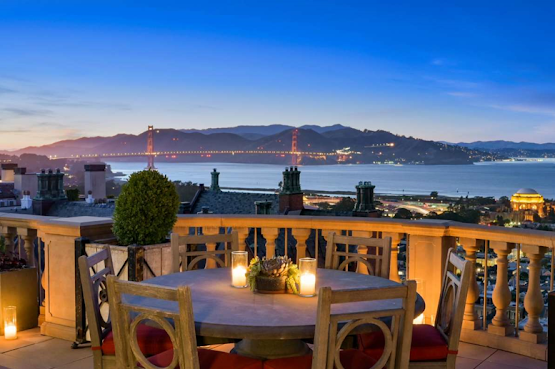
The view from San Francisco's superelite Pacific Heights district -
where homeless are strictly forbidden and quickly removed

The Cautious Optimism Correspondent for Economic Affairs and Other Egghead Stuff prefers the focus of his articles to be on economics, not himself.

However, over four years writing as your trusty Correspondent I’ve frequently been asked this common question:

Q. “Do you really live in San Francisco? How on earth can you stand living in that lunatic bin?"

After having explained the answer to personal friends and family multiple times it just seemed more, well… economical to write the San Francisco survival booklet down once and for all while including some tiny—but far from complete—insight into just how crazy a place San Francisco is.

So the answer in a nutshell, which I’ll elaborate in more detail with many examples, is:

A. “San Francisco *is* a lunatic bin full of insane policies... that mostly don’t affect me.”

So even being free from many of the consequences of loony-left politics, let’s start with what’s to like about the San Francisco area.

MUCH OF SAN FRANCISCO IS STILL PRETTY NICE

The city of San Francisco (referred by locals as “The City”) is still one of the most beautiful cities in the world—mostly. It’s effectively a 7 mile-by-7 mile square surrounded on three sides by San Francisco Bay, the Golden Gate, and the Pacific Ocean. At 49 square miles it’s very small, one-fifth the size of, say, Austin, Texas proper.

It has steep hills, beaches, neighborhoods with Victorian and Edwardian era architecture, mild weather, scenic fog that generates multiple microclimates, great outdoors venues, and for me especially it has great and scenic road bicycling with challenging hills, fun downhills, and cool temperatures.

San Francisco has great food. I’m an Asian foodie who enjoys the variety of Chinese cuisines (the dominant Cantonese plus Taiwanese, Sichuan, and a splattering of Shanghai and northern Chinese), Japanese sushi and ramen, Korean, Thai, Vietnamese, Indian, rare Burmese dishes, and even a little Singapore, Malaysian, and Indonesian.

I also estimate there are literally a hundred restaurants within a 1,000 yard walk from me plus a few more bakeries, boba teas, and bars.

San Francisco also has a great public library main branch that has a surprisingly good inventory of non-socialist economics books (for now), although I often notice I’ve been the first person to check some of them out in twenty years.

San Francisco lefties also feel the need to write their opinions in the margins. For example, once when I was reading a book about Marxism and the author concluded “history has demonstrated Marxism had failed to deliver on its promise to outproduce capitalism” a local leftie wrong “WRONG” in the margin. Well if he felt that strongly then I hope he is enjoying the superabundance of consumer goods living in Cuba or North Korea.

And the library is full of homeless shooting up or bathing in the restroom sinks. My mom from North Carolina likes the library too but exclaimed with a shocked look that “there was a man in the ladies room!” (yeah, it's San Francisco... eye roll) She put it well, concluding “It's a shame that such a beautiful library is infested with so many homeless people.”

THE HOMELESS

Yes, San Francisco has had a major homeless problem for decades and it is growing. The lion’s share of the problem centers downtown around the Civic Center (with government offices, the arts venues, and the public library) and the Tenderloin District although it is spreading into surrounding areas like the Haight, Western Addition, South of Market, the Castro, and even into parts of Union Square, the Financial District, and North Beach.

Feel free to check an online map for these areas.

One of my (rare) conservative friends lives in the Castro, the gay district which has been spruced up over the decades and become a higher-dollar neighborhood, and the last two years small tent cities, trash, and open drug use have mushroomed even on the Castro’s most scenic streets. She trolls the Nextdoor website where the locals now complain endlessly about the homeless invasion, to which she reminds them “Hey, you people voted for this.” To which the reply is either “Orange man bad!” or “You’re a Russian bot!”

When friends visit from out of town part of the world class tours I give includes a drive through the Tenderloin so they can see for themselves how bad the tent cities have become. If we’re lucky we’ll spot some syringes or human poop in time for them to pull out their phone cameras and zoom in before the light turns green.

But homelessness isn’t a problem for your nonconforming Correspondent. 

No way.

I live in a nice area bordering the Presidio, and most importantly I have two of the city’s most ritzy, superwealthy neighborhoods serving as a geographic buffer between me and the problems downtown: Presidio Heights and Pacific Heights.

The difference between Presidio Heights and Pacific Heights is the latter has world-class views of the Bay, and the former’s homes tend to be in the high-single digit million dollar range while the latter is in the double-digit million range. Next comes my neighborhood (Lake Street District) followed by Seacliff, another superelite place with residents like Twitter CEO Jack Dorsey, Sharon Stone, uberliberal presidential candidate Tom Steyer, Robin Williams (up until his death) and George Soros’ son among others.

But all these exclusive fiefdoms share this in common: they’re full of rich limousine liberals who claim to care about the plight of the homeless while having zero tolerance for homeless setting foot in their own neighborhoods.

The moment a vagrant wanders into the edge of any of these districts you can expect an SFPD patrol car to show up within 30 minutes and promptly deport the undesirable out. Because the rich liberals in Seacliff, Presidio Heights and Pacific Heights are happy to vote for policies that make homelessness worse… so long as only the hoi polloi have to live with the consequences—all while they continue to bask in the isolated bubble of their wealthy hypocrisy.

So when it comes time for rich San Francisco lefties to deliver on their promises to the homeless their message is: “What, you say we pledged to help and treat you with humanity? You don’t understand. *We* don’t do that, we just force poorer people to do it for us!”

A personal anecdote: For nearly two decades I’ve rarely seen homeless anywhere near my street, but a few months ago I actually heard a crazy guy screaming at himself as I took an evening walk.

The next day the screaming got louder and I noticed the same guy had parked himself on the sidewalk right across the street from my building, tucked away in a sleeping bag as he screamed himself to sleep at 4AM.

The following morning he was even louder. At 7:30AM I looked outside my 4th floor window to see he had set up shop right outside my building.

But he had company.

Two SFPD patrol cars were curbside with four officers standing there ordering him to pack it up and watching him do it. All the screaming this time was his complaining that he was going to be homeless among middle class and poor residents again.

But if you’re a resident of a lower-echelon neighborhood like the Haight, Castro, Mission, or Lower Nob Hill (only low single-digit million dollars homes) and you call the police to complain about a homeless person, well… you get laughed off the telephone. Suck it up common people!

So that’s a valuable lesson for living in San Francisco. When choosing a neighborhood, if you don’t want to have to deal with poop and syringes move in with the rich hypocrite liberals. They’ll keep voting to ruin the city and brag about how progressive they are at Democratic fundraisers so long as they remain insulated from all the unpleasantness.

SHOPLIFTING, CRIME, AND CLOSURES

San Francisco has been in the news recently because our nutty District Attorney Chesa Boudin—raised by Bill Ayers and did pro bono work for Hugo Chavez, continuing a tradition of his grandfather who represented Fidel Castro and great grand-uncle who was a famous Marxist theoretician—is super-duper soft on criminals. Especially those criminals of historically underserved ethnic groups whom he either doesn’t charge and/or lets free, then calling his policy “restorative justice.”.

So Walgreens has closed nearly twenty stores due to ongoing property theft and also reduced hours of many of their other stores.

But the rich locals I live around don’t tolerate undesirables in their neighborhoods so nope, my Walgreens hasn’t closed. You can bet if it ever does THEN the wealthy locals will demand city government gets tough on crime.

The biggest inconvenience—and this is the first problem that has actually affected me—is Target has also tired of unpunished shoplifting and now closes all its city locations at 6PM, although one can still drive out seven or eight miles to Daly City or Colma and shop until 10PM (I have a car but many locals aren’t so mobile, a subject for another column).

One more rising problem is car breakins. Those tend to be focused in tourist areas since criminals know the chances of a tourist flying back from the East Coast or Asia for a trial that never happens anyway are virtually nonexistent. But breakins are still a problem citywide.

So far I haven’t had one yet because everyone learns “don’t leave anything that looks valuable in plain sight in your car and your odds of being a victim will drop 95%.” Plus I have a one-car garage to myself in my building—a luxury in this city—which really, really helps. Many residents have to park their cars every night curbside which adds another fiftyfold risk to being a breakin target.

DRIVING OUT BUSINESS AND JOBS

Yes, San Francisco’s constantly rising taxes and corruption have chased a lot of businesses away. Right after voters passed a “gross receipts tax” in 2018 (0.5% of any large company’s topline revenues) pharmaceutical distribution giant McKesson announced it was moving its headquarters from San Francisco to Irving, Texas.

Shortly afterwards Charles Schwab relocated to Westlake, Texas. Bechtel shipped its headquarters out to Reston, Virginia. Countless other smaller corporations have left in the last three years such as SoFi, Square, Lyft, and Core-Mark, and many large Bay Area companies have announced relocations to Texas like Hewlett Packard Enterprise, Oracle, Palantir Technologies, and just recently Tesla.

The pandemic has also helped ship tech jobs and offices out of San Francisco. All the work is remote so no need to pay for expensive office space that no one is using.

But this doesn’t affect me either. My day job has been voice telecommunications consulting and architecture for over twenty years and over all that time my clients have been outside San Francisco and usually outside California.

In other words my job isn’t reliant on a healthy California economy. San Francisco politicians can turn the city into an economic North Korea (some of them would like that) and I still keep working.

I’ll continue in Part 2 with the biggest economic albatross of all in San Francisco: housing costs.

Sunday, October 24, 2021

Twenty More British Power Suppliers at Risk of Bankruptcy due to Regulatory Price Caps; Press Calls it "Deregulation"

Click here to read the original Cautious Optimism Facebook post with comments

2 MIN READ - Last week the Cautious Optimism Correspondent for Economic Affairs and Other Egghead Stuff reported that the twelfth British retail gas/power supplier since September had failed under the weight of rising wholesale energy prices.

What makes Britain more crisis-prone is that its power regulator Ofgem (Office of Gas and Electricity Markets) allows wholesale prices to rise or fall without limit but caps retail rates, restricting private power suppliers from passing higher natural gas/power generating costs on to customers. Hence in the midst of the energy crisis suppliers are paying a lot more to produce electricity but aren't allowed to charge more to deliver it.

The Correspondent also compared Britain’s problem to California’s 2000 electricity crisis when the state government also allowed wholesale energy prices to rise with the market and also strictly capped retail rates, spawning widespread blackouts, forcing power giant PG&E into bankruptcy and nearly bringing down Southern California Edison save a last minute rescue package from Sacramento.

You can read more details of California’s failed electricity experiment at:

http://www.cautiouseconomics.com/2021/10/energy-16.html

At the time the Correspondent predicted British left-wingers would call their price-capped power crisis “deregulation” and “free market capitalism” just as Californians have mislabeled their own disaster for over 20 years.

Well the verdict is still out on the left-wingers, but not for the press (then again, the latter has become just a genus of the former's larger family). Reuters is now reporting twenty more British suppliers are teetering on bankruptcy while referring to the bizarre price-capping arrangement as “deregulation.”

("Britain faces 'massacre' of 20 more bust energy suppliers, Scottish Power says": Reuters)

https://www.reuters.com/business/energy/energy-market-massacre-looms-britain-scottish-power-chief-says-2021-10-21

Two passages from the story:

“Britain's energy market faces an absolute massacre that could force at least 20 suppliers into bankruptcy in the next month alone unless the government reviews the energy price cap, Scottish Power Chief Executive Keith Anderson said on Thursday…”

"...We are now going to start seeing some relatively well-run, good, commercially sound businesses going bankrupt because they just can't pass the cost of the product through to customers."

And written in the middle of literally eight mentions of the price cap and price regulator:

“The soaring natural gas prices have strained Britain's retail energy markets to breaking point, putting into question 30 years of energy deregulation which began in 1989 under then-Prime Minister Margaret Thatcher.”

Which leads the Correspondent to ask a reasonable question: “What do the Reuters editor’s desk and journalism schools think the definition of ‘deregulation’ is?” Because evidently their dictionary defines it as “anything that goes wrong in a government-controlled marketplace.”

Call me old-fashioned, but I always thought “deregulation” meant “no government interference in the economy” which definitely includes "no price controls."

At minimum Reuters could describe Britain's power market as "retail-regulated" or "partially regulated," but then my generation probably isn’t woke enough to understand.

In case you can’t get past the Reuters paywall Yahoo! has rerun the story at:

https://www.yahoo.com/news/uk-faces-energy-massacre-20-064856528.html

Wednesday, October 20, 2021

Rising Inflation and Just One Possible Alternative Theory to "Supply Chain Issues"

 Click here to read the original Cautious Optimism Facebook post with comments

The Cautious Optimism Correspondent for Economic Affairs and Other Egghead Stuff has seen no shortage of what appears to be coordinated news headlines pinning recent elevated price inflation on "supply chain issues."

Well he’d like to offer a small alternative theory via this simple chart from the Federal Reserve:

There are 35% more dollars circulating in the U.S. economy than there were 19 months ago.

Actually, the Correspondent has written in more detail on the money supply factor in a previous entry (see below) but is also growing tired of the media chanting presumptively that the "supply chain" theory is the only explanation.

Does anyone think a 35% increase in the M2 money supply and the Fed's unwillingness to-date to restrain its continued growth might be relevant enough to warrant just a little media mention? 

Or has the money supply become the economic equivalent of Hunter Biden's laptop?

ps. Since Facebook only allows one photo per post, please check these additional charts/URL's for money supply aggregates in Canada, the United Kingdom, and the Eurozone. The press blames “supply chain issues” for global price pressures, but does anyone see anything else in common in all these places?

Canada:

UK:

Eurozone:


Sunday, October 17, 2021

Britain’s 2000 California Energy Crisis

Click here to read the original Cautious Optimism Facebook post with comments

6 MIN READ - The Cautious Optimism Correspondent for Economic Affairs and Other Egghead Stuff uncovers key parallels between California's 2000 electrical power crisis and Great Britain's current one.

Britain’s third gas/electricity supplier has failed this week, the twelfth since September, leaving its assets in the hands of U.K. power regulator Ofgem (Office of Gas and Electricity Markets) to take over and determine the failed operator's final disposition.

Read details at:

https://www.yahoo.com/now/daligas-becomes-third-uk-energy-143859141.html

However this string of bankruptcies isn’t due simply to rising energy prices. The USA and Canada have had multiple energy price spikes over the last two decades (2000, 2005, 2008, 2010-2014) and they’ve never precipitated waves of mass bankruptcies among utilities.

Except in California in 2000-2001.

Twenty years later the U.K. is undergoing the same purge for similar reasons. To understand why it helps to revisit California’s 2000-2001 power crisis for a moment.

(Note: Although the U.K. is technically Great Britain plus Northern Ireland I will use the two names interchangeably in this article. British readers please accept my apologies for the technical error.)

PARALLELS

Older CO readers may remember news headlines about rolling blackouts in California two decades ago plus subplots about the bankruptcy of power giant PG&E (yes, another one) and the near-bankruptcy of Southern California Edison which was only saved at the last minute by a rescue deal with the state government.

So why were there blackouts and utility bankruptcies throughout California while the rest of the USA, which also experienced higher prices, was relatively calm?

The reason lies with California’s unique electricity regulations.

A major electrical power reform negotiated between Republican Governor Pete Wilson and the Democratic legislature was enacted in 1996 (the late 1990’s was a period of historically low energy prices). Among the major provisions of the regulations were:

1. Wholesale energy and power rates paid by California utilities were to be deregulated, allowing prices to move freely.

2. Retail prices charged by California utilities were to be capped by regulators, strictly limiting their ability to raise rates.

Already some readers might be able to see the problem this would inevitably create. So long as diesel, natural gas, or wholesale electricity prices remained low, retail price caps wouldn’t pose a problem. But the moment energy prices spiked, California utilities would have to pay spot prices on the open market but would be legally prohibited from passing those higher costs on to customers, generating huge financial losses.

Worsening matters is simple microeconomics. When demand for a commodity like power exceeds supply, a rising price encourages conservation and discourages waste by consumers. But given that state regulators wouldn’t allow rate hikes at precisely the moment they were most needed—when a critical supply-demand imbalance appeared—customers would have no incentive to alter their consumption behavior. Hence, rolling blackouts.

In what the Correspondent views as a sick and uninformed joke these reforms were called, and remain called to this day, “energy deregulation." And when the inevitable crisis struck, California liberals blamed and still blame the disaster even today on “free market capitalism.”

Which brings us back to the U.K.

Recently failed power supplier Daligas released a statement citing “unprecedented energy market conditions, the record high wholesale prices and the current energy cap set by the industry regulator Ofgem” for their inability to continue operating as a going concern.

Reuters has also reported that “Many British energy firms, often supplying both gas and electricity to homes and businesses, have struggled with soaring wholesale energy costs because of the regulator's price caps, which limits how much of the price rise they can pass on.”

Sounds just like California in 2000.

Hopefully Ofgem will allow U.K. energy suppliers to raise rates higher (and soon) allowing them to save themselves from bankruptcy, but the Economics Correspondent suspects British socialists and left-wingers are already blaming “free market capitalism” and “deregulation” for their nation’s power woes. And just like California, they’ll probably keep blaming "capitalism and deregulation" twenty years from now too.

Keep reading if you’d like to learn more absurdities about California’s power “deregulation.”

2000: YET MORE CALIFORNIA DYSFUNCTION

Another bizarre “deregulation” that California imposed on its suppliers was a ban on wholesale price hedging, a tool that utilities—along with airlines, oil and gas producers, and a slew of other industries vulnerable to rapid changes in commodity pricing— routinely use to protect themselves from price volatility .

California utilities wanted to buy long-term contracts locking in wholesale energy prices to reduce the impact of potentially skyrocketing rates. But the Sacramento legislature, in its infinite wisdom, made hedging illegal. 

The reasoning? If utilities locked in wholesale rates while they were low and then charged a higher, regulated retail rate, they might make more profit than the government considered acceptable. And we all know “too much profit” is a capital offense that must be prevented at all costs in California.

Well the legislature did prevent it, and at dear cost indeed.

When energy prices spiked in 2000 California suppliers were forced to pay high prices on the spot market which, again, they were forbidden from passing on to their customers. Once natural gas and diesel rates became prohibitively high California suppliers attempted to buy power from out-of-state but, legally restricted from locking in prices with hedging, found themselves forced to pay high spot market rates there too.

Some Californians love to dismiss the hedging prohibitions and blame energy traders like Enron for “market manipulation.” And it is true that when demand and prices started to rise Enron traders used clever strategies to charge even higher prices. One famous example is Enron overbooked a critical transmission line that connected the state’s northern and southern power grids, creating a bottleneck for power distribution which allowed it to charge even more to move power from one half of the state to the other.

What critics don’t mention is that a letter from an Enron whistleblower to Barbara Boxer’s office revealed that “There is a single connection between northern and southern California's power grids. I heard that Enron traders purposely overbooked that line, then caused others to need it. Next, by California's free-market rules, Enron was allowed to price-gouge at will.”

Well sure, when there’s only a single connection serving as transmission corridor between two population centers of 15 million and 23 million people it’s a lot easier for a canny firm to clog it up, create bottlenecks, and price gouge than when there are several connections. 

And whose brilliant idea was it to allow only a single transmission line (when private suppliers had applied for years to construct additional ones)? California's regulator, the Public Utilities Commission.

Imagine airports in New York and Los Angeles, each with multiple runways and 100+ gates, but the Department of Transportation limits the number of slots (allowed landings) to just two per airport per day. One firm can more easily buy up huge "market share" and create scarcity/higher prices than if the government permitted the literally thousands of slots it does at those two airports today. 

As further evidence, in 2000 other states had also enacted varying degrees of power deregulation, and Enron and other greedy energy traders were operating throughout. Yet only California suffered from statewide rolling blackouts and the failure or near failure of giant utilities that served over 30 million people.

Finally, as suppliers fell into crisis or conservatorship, California’s Democratic Governor Gray Davis invoked emergency powers authorizing the state government to buy electricity on behalf of private utilities to stop the blackouts.

Ironically Davis, who had previously championed restricting private suppliers from hedging on wholesale prices, granted himself the freedom to do exactly that. Evidently it’s OK for the government to use everyday market tools to limit its losses but not the private sector.

And in a follow-up act of astonishing stupidity Davis immediately signed long-term contracts with out-of-state providers, locking in natural gas and electric power at astronomically high prices. Now California government was committed to paying a crisis premium for years.

When the crisis abated shortly after and wholesale prices fell, Davis tried to renege on his hedging contracts and demanded suppliers accept lower payments from the state. Wholesalers obviously refused, holding him to the terms of the hedging contracts he had voluntarily entered into.

California’s Treasurer warned Davis that overpaying billions of dollars for electricity was blowing a hole in the state budget, and the state filed suit against suppliers for lower rates, but the Economics Correspondent doesn’t recall the final court ruling.

However Alaska Republican Senator Lisa Murkowksi confirmed this story in her statement during Congressional hearings on the crisis:

“The State of California signed billions of dollars of long-term power supply contracts on behalf of the investor-owned utilities. Keep in mind that the State prevented the IOU's from long-term contracts in the first place.”

“When the State signed contracts, when they proved to be far above the market, putting California taxpayers on the hook for billions of dollars, guess what happened? Well, we see that in the paper as Governor Davis proclaims his predicament. California, according to Governor Davis, is trying to abrogate the contracts and place the blame on industry, not just Enron.”

In the end, the electric power debacle, combined with his attempt to fill the state budget shortfall by imposing $1,000+ annual car registration renewal fees, brought about the fall of Gray Davis. A successful recall effort was launched resulting in the election of Arnold Schwarzenegger as new state governor.

Friday, October 15, 2021

Larry Summers Slams Woke Fed for Risking Losing Control of Inflation

Click here to read the original Cautious Optimism Facebook post with comments

The Cautious Optimism Correspondent for Economic Affairs and other Egghead Stuff agrees with the mantra "When you're right, you're right. Even if you're an overrated New Keynesian economist."

Summers was also pretty good warning in March that the pork-laden $1.9 trillion Biden "Covid rescue package" (over $1 trillion of which had nothing to do with Covid, unemployment, or stimulus checks) would elevate inflation risks.

His list of problems today is also very good except for "excess household savings" which is not the problem... at all.

"Former Treasury Secretary Lawrence Summers castigated monetary policy makers in the U.S. and elsewhere for paying too much attention to social issues and not enough to the biggest risk to inflation since the 1970s."

“We have a generation of central bankers who are defining themselves by their wokeness,” Summers, who is now a professor at Harvard University, said on Wednesday. “They’re defining themselves by how socially concerned they are.”"

<snip>

"Summers ticked off a number of reasons for what he called his “very considerable concern,” including ultra-lax monetary policy, surging house prices, a big federal budget deficit and excess household savings."

https://www.bloomberg.com/news/articles/2021-10-13/summers-slams-woke-fed-for-risking-losing-control-of-inflation

If you can't get past the Bloomberg paywall a Google cached URL with free access is available at:

https://webcache.googleusercontent.com/search?q=cache:RlFJT3XWAPEJ:https://www.bloomberg.com/news/articles/2021-10-13/summers-slams-woke-fed-for-risking-losing-control-of-inflation+&cd=1&hl=en&ct=clnk&gl=us