Wednesday, April 5, 2023

If You Think SVB Was Undiversified, Just Look at America's First 150 Years

Click here to read the original Cautious Optimism Facebook post with comments

5 MIN READ - The Cautious Optimism Correspondent for Economic Affairs and Other Egghead Stuff compares Silicon Valley Bank’s now-heavily criticized lack of asset and depositor diversification with that of regulated unit banks during America’s past.

Now that multiple postmortems have been performed on the failure of SVB a consensus has emerged that its collapse was, in the words of Federal Reserve Vice Chair of Supervision Michael Barr, a “textbook case of mismanagement.”

Citing examples of SVB management’s failures, Barr and others have pointed to its overreliance on long-term U.S Treasury and mortgage securities in a zero-interest rate environment and a lack of depositor diversification.

Of course even with those mistakes SVB still wouldn’t have failed were it not for the Fed's fifteen years of near-zero interest rate policy running head-on into a twelve month, 500 basis point rate hike wall. But that’s another story.

But back to diversification, it’s been thoroughly reported by now that SVB loaned heavily to high-tech and healthcare companies and that its deposit base was also heavy in those same sectors.

In fact, according to the company’s website its clients included a full 44% of all venture-backed technology and health care initial public offerings in 2022.

According to Ernst and Young there were 328 technology IPO’s that year and another 168 in healthcare.

The Correspondent doesn’t know exactly how many of those 496 IPO’s were “venture-backed,” but given the nature of IPO’s in those two fields he’d wager “majority” is a conservative call.

Add IPO clients from years before 2022, corporate accounts from other industries, and high net worth individuals and the Economics Correspondent can confidently estimate SVB’s large depositor base at many hundreds of accounts if not in the thousands. After all, in its last SEC-10-K filing SVB reported $186 billion in deposits so even a high estimate of one thousand large accounts would still average a whopping $186 million each (excluding small accounts). 

UNIT BANKING RULES EARLY AMERICA

Now let’s go back in time to the early 20th century.

Cautious Rockers may recall the Economics Correspondent wrote in detail last year about American “unit banking” laws that, for most of U.S. history, heavily restricted the right of banks to open branch offices.

Most states forbade banks from branching at all. Legislatures literally specified “one building” in their statutory language to define chartered banks, and 100% of states forbade branching into other states.

The result? In 1914 the United States had about 27,000 banks of which 95% were tiny and had no branches. Even the remaining 5% of banks that were allowed to branch averaged only five branches each (Calomiris & Haber, 2014)

The political rationale behind these restrictions was complicated and involved stuffing state government coffers with rent-seeking monopoly unit bank profits. Links to the Correspondent’s articles containing more of those details can be found in the comments section.

However the predictable result was—you guessed it—a protracted lack of diversification in America’s entire banking system that was far worse than SVB which looks like a multinational money center bank by comparison.

The nearly 26,000 U.S. banks with no branches were usually one building in a small rural town. Granted a monopoly to operate in that township, the unit bank was heavily reliant on the price of a single regional crop. And a few miles down the road in the next town would be another monopoly unit bank, also heavily dependent on just one local crop.

And depositor bases were nearly as narrow. In a town of a few hundred people, a handful of the wealthiest locals could constitute the majority of the unit bank’s entire deposit base. Just one or two wealthy customers getting nervous and cashing out in times of trouble could bring down a unit bank.

This “unit banking” structure goes all the way back to 1784 when America’s first two banks still in operation today—the Bank of Massachusetts and the Bank of New York—were granted local monopolies alongside their new charters.

The result was nearly 150 years of massive financial instability for the entire country. Falling prices in just one or a few different crops could bring down hundreds or even thousands of unit banks whose loans were dependent entirely on local agriculture or on loans to consumers and small businesses whose fortunes were also tied directly to local agriculture.

As one example informs us, food prices fell globally in the 1920s, the aftermath of World War I and European soldiers returning from the battlefield to farm again. During that decade over 5,000 American banks failed.

And this all happened before the Great Depression had even started. In the early 1930’s over 9,000 more banks failed.

Note: Canada never had any restrictions on bank branching so even as it weathered the Great Depression alongside the United States, zero Canadian banks failed. Canadian banks were larger, better-capitalized, typically had several hundred nationwide branches, and diversified their loans across the country’s entire economy with literally hundreds of thousands or even millions of depositors.

AND THEY SAY SVB WASN’T DIVERSIFIED?

So what’s the point of going back to the early 20th century?

Well if the press and regulators are now declaring:

“Of course SVB was mismanaged: it relied on only a thousand-plus large depositors, loans heavily focused on tech and healthcare companies, and Treasury and mortgage-backed securities”

…all which is true, what do they have to say about U.S. banks a hundred years ago that were forced by law to rely on just a single crop and couldn’t expand outside a town of a few hundred people?

If SVB’s business model was a recipe for collapse and failure, then much more draconian unit banking regulations were a prescription for waves of nationwide bank failures and systemic crisis. 

And that’s exactly what happened—over and over again.

From 1792 to 1933 the United States was rocked by fifteen systemic banking panics while Canada experienced zero.

Unit bank laws were a primary driver of these repeated crises although, if you can believe it, they weren’t even the only bad regulations.

Adding fuel to the fire were the missteps of America’s three central banks—the Bank of the United States (1791-1811), the Second Bank of the United States (1816-1836), and the Federal Reserve System (1914-present)—alongside yet more complicated regulatory restrictions that undermined bank stability during the National Banking System era of 1863-1914.

So if we look at the level of undiversified risk at SVB—which the press and regulators are all calling “textbook mismanagement”—and compare it to the far worse lack of diversification at America’s 19th and early 20th century banks, one can see how financial crises were triggered so easily for 150-plus years.

Only unlike SVB, the lack of unit bank diversification wasn’t by choice. Rather it was mandated by Congress and state legislatures.

====

Postscript: Just a moment ago the Economics Correspondent asked rhetorically: “What do they [regulators, the press, and let’s throw in academia] have to say about U.S. banks a hundred years ago that were forced by law” to stay unbranched and far more undiversified than SVB?

Well here's a few responses: 

1) “For most of the 19th century and into the 20th century, laissez-faire attitudes and minimal state regulations led to a succession of financial panics.”

-Jon Talton, Seattle Times

2) “Andrew Jackson had famously allowed the charter of the Second Bank of the United States to expire in the 1830s. With only loose regulation, the financial system was decentralized and rudderless… …so the industrializing United States suffered a continual spate of financial panics, bank runs, money shortages and, indeed, full-blown depressions.” 

–Daniel Gross, Washington Post

3) “History tells us that banking is subject to occasional destructive “panics” that can wreak havoc with the economy… …Gilded Age America — a land with minimal government and no Fed — was subject to panics roughly once every six years.”

-Paul Krugman, (New York Times)

4) “An unregulated banking system in the nineteenth century contributed to a string of severe money panics. A short play in this lesson plan helps students understand why this happened and how today’s Federal Reserve System protects against panics.”

-National Council on Economic Education, New York

5) "With the failure to recharter the First Bank of the United States in 1811, regulatory influence over state banks ceased. Credit-friendly Republicans—entrepreneurs, bankers, farmers—adapted laissez-faire financial principles to the precepts of Jeffersonian political libertarianism."

-Wikipedia article on the Panic of 1819

Saturday, April 1, 2023

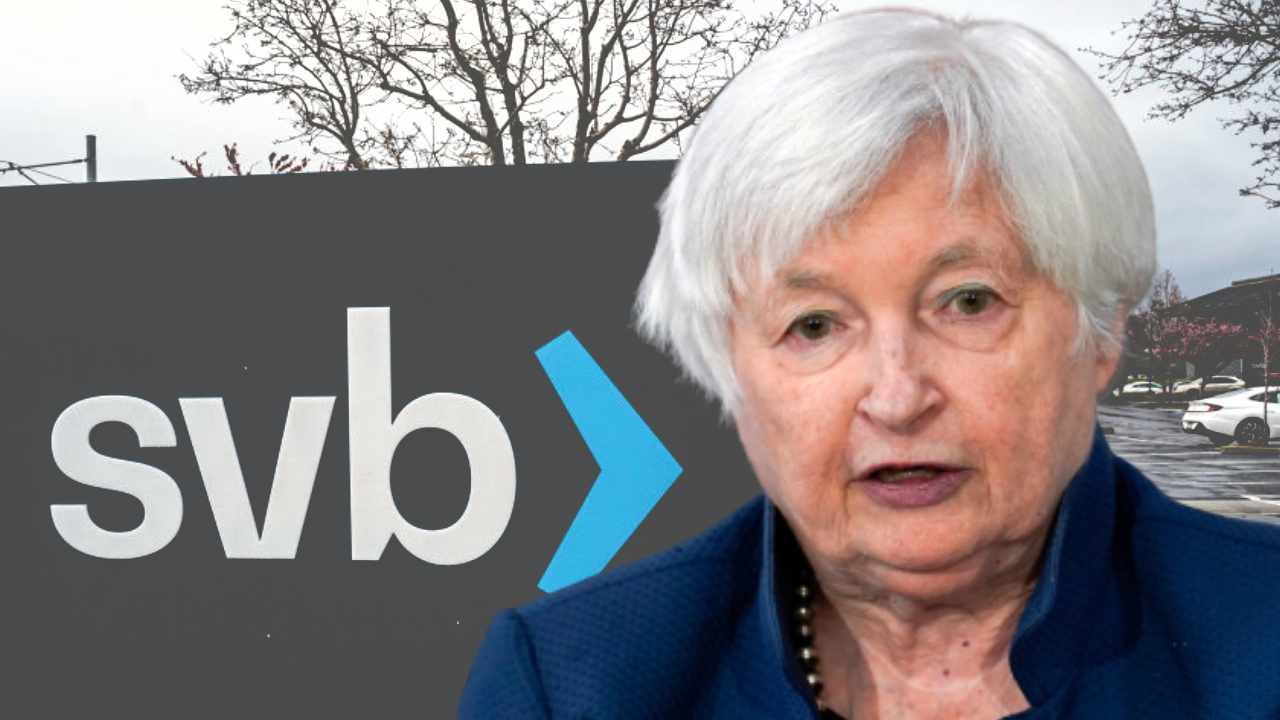
Janet Yellen: Trump Cut Eighteen Jobs At Treasury!

Click here to read the original Cautious Optimism Facebook post with comments

5 MIN READ - An update from the Cautious Optimism Correspondent for Economic Affairs on the Biden administration’s latest “blame Trump for SVB’s failure” evasion. 

In the Biden administration’s latest attempt to deflect blame for the failure of Silicon Valley Bank—which happened two years and two months into their watch—Treasury Secretary Janet Yellen this week blamed yucky Orange Man Bad for reducing staff at the Treasury Department’s Financial Stability Oversight Council (FSOC) from 36 employees to 18 and pleaded that she has worked tirelessly to increase its staffing since she took office.

Yellen on Thursday: “When the President and I took office in January 2021, we inherited a financial stability apparatus at Treasury that had been decimated."

Read more at:

https://finance.yahoo.com/news/janet-yellen-says-trump-administration-174814711.html

The message of course is “Don’t blame us. We saw the tremendous risk caused by Trump’s deregulation and budget cuts, but we were powerless to do anything about it in time. Otherwise we would have prevented SVB’s failure.”

Aside from the media and nearly half of America lapping up this latest excuse just before inhaling and regurgitating it back onto their smartphone screens, here are just a few of the problems with Yellen’s poorly-authored alibi:

1) Federal Reserve Vice Chair for Supervision Michael Barr testified last week that his office already audited SVB many times going back to 2021 and found multiple “deficiencies” and management problems before ordering the bank to take corrective measures. Clearly a smaller staff in one tiny Treasury Department office didn’t prevent the discovery of problems at SVB. 

Barr also stated that despite finding deficiencies at SVB there was a failure of supervision within his office’s procedures, so money for eighteen bodies at Treasury wasn’t going to resolve what was clearly an execution problem at the Fed.

May 9, 2023 addendum: A newly filed report from California's bank regulator, the California Department of Financial Protection and Innovation, blames itself for SVB's failure and claims it (according to AP) "did not act forcefully enough to get the bank to fix its problems."

2) Despite framing herself as clairvoyant enough to see in early 2021 the tremendous risk evil Orange Man created by reducing the FSOC’s staff, the Economics Correspondent can’t find a single instance of Yellen warning of systemic financial risk in the last two-plus years. 

Surely if she “saw it all along” and identified an existential threat to the financial system that threatened to usher in another Great Depression she would have spoken up publicly?

But she didn’t.

Strange for someone who was acutely aware of so chilling a threat to remain silent… unless she didn’t really see it and is now just playing CYA after the fact.

3) Not only did Yellen never warn about the great dangers ahead, but during the last two-plus years she found time to speak publicly and in Congressional testimony about the following issues that were more important than a novel threat of systemic financial crisis:

-SNAP benefits
-Electric vehicle credits
-Community college subsidies
-Diversity initiatives
-George Floyd’s murder
-Biden’s Covid deficit spending packages
-Harriet Tubman’s face on the $20 billZ
-Appointing Treasury’s first Counselor for Racial Equity
-Flying the gay pride flag outside the Treasury building
(this is only a partial list).

These policy priorities were all important enough to bring public attention to but the looming threat of financial crisis due to 18 empty cubicles in a corner of the Treasury building was not.

4) Given that Yellen publicly stated in 2017 the USA would not see another financial crisis in our lifetimes, one would think if she was alarmed at how yucky Orange Man was inviting another crisis with his budget cuts she would have acted to protect her reputation by immediately and pre-emptively screaming at the top of her lungs:

“Earlier I said we wouldn’t see another financial crisis in our lifetimes but right now in January of 2021 I rescind that statement because look at the danger Trump has created!”

Forget even covering for her 2017 statement. Wouldn't any career bureaucrat, seeing the threat of crisis blowing up in their faces, want to get out in front of the problem for political insurance and announce (before the crisis explodes and takes them down) "We've found this problem left to us by Trump and we're working to fix it right now before it's too late?"

Instead she was dead silent. Now she’s eating her own words about “no financial crisis in our lifetimes” even though, according to her, she saw the problem for over two years? Yeah, like that’s believable.

5) Multiple times in her tenure at Treasury Yellen actually *praised* the stability of the banking system during the stresses of the 2020 Covid pandemic--and credited the current regulatory regime. 

Yet we’re now expected to believe that all the time she was holding up the bureaucratic structure as steadfast/resolute she secretly knew it was wide open to a new financial crisis and never said a word?

Not likely.

Obviously the evidence points to a far more plausible explanation: Yellen and the entire Biden administration were blissfully confident that the regulatory system they oversaw was bulletproof on autopilot and then taken by surprise by SVB’s collapse. 

Now that they are being criticized for dropping the ball after two-plus years in power, they’re scrambling to blame someone, anyone other than themselves.

And who are their supporters more likely to believe is responsible than Trump? They could accuse Trump of causing the Chicago fire of 1871 and most Democrats would not only believe it, they'd share it with all their friends and call anyone racist for pointing out Trump wasn't born until 75 years later.

And their alibis are as poorly thought through and crumble in the face of five seconds of scrutiny. But that doesn’t matter to the TDS-afflicted who willingly believe anything so long as the message is Orange Lucifer evil.

There’s one more about the budget cuts.

6) Although Yellen only became Treasury Secretary in early 2021, the Democratic Congressional leadership had every chance to restaff the FSOC when they controlled the House of Representatives starting in January of 2019.

Democrats controlled all the oversight committees and knew all the details of the budget for Treasury. Surely with Maxine Waters heading the Financial Services Committee they could have plugged the tiny hole that threated America with a financial tsunami.

What, they didn't control the Senate yet?

That didn't stop the Pelosi House from successfully holding both of Trump’s Covid CARES packages hostage in 2020 and early 2021 to get hundreds of billions of dollars of pork added to the bills while Americans waited in their locked homes for help.

We’re told that adding a few million dollars’ pittance for FSOC to the combined $3.4 trillion in two CARES packages would have snuffed out the menace of another Great Financial Crisis for good, yet instead Pelosi and the Democrats secured hundreds of billions of dollars for more important priorities like gender diversity programs in Pakistan, race riot studies, Kennedy Center remodeling funds, a Women’s History Museum and Latino Museum, foreign aid to Burma, Cambodia, Sudan, Nepal, and Ukraine, diversity on U.S. airline corporate boards, funds for “freshwater mussel hatcheries,” LGBT-friendly senior housing in Dallas, and.... 

Well that’s just part of what was in the 5,539 pages of the first CARES Act alone.

Tuesday, March 28, 2023

Free vs Regulated Banking: Did Canada's Glass-Steagall Safeguard its Banks in 2008?

(Spoiler: Canada didn't have a Glass-Steagall)

Click here to read the original Cautious Optimism Facebook post with comments

The Cautious Optimism Correspondent for Economic Affairs and Other Egghead Stuff explores Glass-Steagall regulations as they relate to the Canadian banking industry and the 2008 financial crisis.

Sen. Carter Glass and Rep. Henry Steagall

During the 2008 Great Financial Crisis it became stylish in some circles to blame the upheaval on the repeal of a single provision from the 1933 Glass-Steagall Act: the separation of commercial banking from investment banking. In the fifteen years since Senator Elizabeth Warren has been one of the loudest and most consistent voices blaming the 1999 partial repeal, known also as the Gramm-Leach-Bliley Act, for the crisis.

Aside from the fact Glass-Steagall never existed in European countries like France, Germany, and the UK, all of which avoided systemic financial crises for 75 years, there are several problems with the “bring back Glass-Steagall” theory:

Due to the Johnny-come-lately nature of Gramm-Leach-Bliley, virtually no integration of commercial and investment banking had even taken place in the United States before 2008. Critics blame the crisis on a massive union of business lines that didn’t yet exist.

And an even bigger problem is that Canada has had integrated commercial and investment banking operations at its major banks for a much longer time than the USA. In stark contrast to the USA, by the 2000’s decade all of Canada’s “Big Five” commercial banks had long-since integrated investment banking into their operations.

According to the Glass-Steagall lobby Canadian banking should have suffered an even larger crisis than the United States in 2008, yet it experienced no crisis whatsoever.

GLASS-STEAGALL DURING THE GREAT DEPRESSION

First let’s quickly review what Glass-Steagall was: a Great Depression-era series of banking reforms cosponsored by Representative Henry Steagall (D-AL) and Senator Carter Glass (D-VA) who chaired their respective House Banking and Senate Appropriations committees.

Also known as the Banking Act of 1933, Glass-Steagall contained four major provisions:

1. The introduction of federal deposit insurance through the establishment of the FDIC

2. The creation of the Federal Open Market Committee (FOMC) to conduct monetary policy

3. Regulation Q: Prohibiting banks from paying interest on demand deposits and strict limits on interest paid for other forms of deposits (repealed in 1980)

4. The separation of commercial banking and investment banking activities within the same institution (repealed in 1999)

Ironically, only one of the four provisions did anything to help avert future banking panics (deposit insurance) and two of the provisions were actually anti-competition measures designed to protect politically favored banks (deposit insurance and Regulation Q).

Both anti-competitive provisions were championed by Henry Steagall who represented an unstable unit banking state. Regulation Q was meant to stop monopoly unit banks from losing customers to other monopoly unit banks in neighboring counties, and deposit insurance was designed to protect unit banks from their own unstable structure: undiversified loan portfolios and undiversified depositors stemming from state laws limiting them to a single office in small, rural towns.

The creation of the FOMC can be argued to have actually made the banking system more unstable as monetary policy, the Fed’s buying and selling of assets to manipulate interest rates and the quantity of reserves in the banking system, has produced larger and more destructive credit boom-bust cycles.

And lastly the separation of commercial and investment banking was written at the insistence of one man: Carter Glass—who was convinced in his strange belief that a crossover between lending deposits and underwriting securities caused the great banking crises of the early 1930’s.

However even mainstream economists have recognized for decades that the depression-era crises were due to unit bank laws and the multiple failures of the Federal Reserve. Of the over 9,000 banks that failed between 1929 and 1933 the vast majority were small unit banks in rural areas, hardly active in underwriting new Wall Street stock offerings or corporate bonds.

Nevertheless, Glass’ powerful Appropriations Committee chair provided the clout to successfully push the investment banking provision into law.

AMERICAN INVESTMENT BANKS IN THE 2000’s

The legal barriers separating commercial and investment banking were repealed in November of 1999 meaning financial institutions only began working on merger/acquisition prospects in 2000 and 2001. 

Most did not.

And a key fact many proponents of Glass-Steagall are unaware of is by early 2008 all of America’s leading five investment banks:

-Goldman Sachs
-Morgan Stanley
-Merrill Lynch
-Lehman Brothers
-Bear Stearns

…and top five commercial banks:

-Citigroup
-Bank of America
-JP Morgan Chase
-Wachovia
-Wells Fargo

…were still standalone entities with little to no crossover activity. 

The Big Five investment banks had not merged with any major commercial bank, and the Big Five commercial banks had not merged with any major investment bank.

Despite actively seeking to combine their commercial and investment banking operations, there simply hadn’t been enough time for suitable market conditions to produce attractive merger propositions. And attempts to grow crossover divisions organically were miniscule and slow with Citi and JP Morgan being the closest to having any meaningful investment banking activity at all.

In fact far from having combined in the early 2000’s, it was the financial crisis itself and near-failure of several investment banks that finally gave America’s commercial banks the golden opportunity they had been waiting for: the chance to acquire a major investment bank and finally enter the securities underwriting, M&A, wealth and asset management, and sales and trading businesses writ large. 

In early 2008 J.P. Morgan rescued Bear Steans from collapse through an eleventh-hour government-brokered acquisition. Regulators hoped the buyout would avert a wider financial crisis (they were proven wrong within a few months).

And in a notorious government-pressed shotgun wedding Bank of America bought Merrill Lynch during the depths of the 2008 fall crisis.

Incidentally, the J.P. Morgan/Bear Stearns and Bank of America/Merrill Lynch rescues would have been illegal under Glass-Steagall’s original restrictions. Had the rules not been repealed in 1999, the number of major investment bank failures would have grown from one of the Big Five (Lehman Brothers) to three (Lehman + Bear + Merrill), deepening the crisis and subsequent Great Recession.

Today only two of the original five investment banks remain independent entities: Goldman Sachs and Morgan Stanley.

RESILIENT CANADIAN INVESTMENT BANKS

Canada once had its own version of Glass-Steagall: the so-called “Four Pillars” that separated commercial banking, investment banking, securities trading, and insurance.

In 1987 the conservative Mulroney government freed the first three pillars to be integrated (leaving insurance separated out). The so-called financial “Little Bang” allowed commercial and investment banks to merge a dozen years before U.S. Congress passed the Gramm-Leach-Bliley Act.

Right away Canada’s “Big Five” commercial banks began acquiring securities trading and underwriting firms. Each of their first forays were:

-1987: Toronto Dominion Bank acquires TD Securities*
-1987: Bank of Montreal acquires Nesbitt Thompson
-1987: CIBC acquires CIBC Securities*
-1988: Royal Bank of Canada acquires Dominion Securities
-1988: Scotiabank acquires ScotiaMcLeod*

(* indicates rebranded name)

By the early 2000’s all of Canada’s Big Five had fully integrated investment and securities divisions into their business models, following the so-called “financial supermarket” strategy that had already taken hold in Europe and Asia. By 2008 a few Canadian superbanks were also major players on the global investment banking stage—RBC/Royal Bank of Canada, Toronto-Dominion Bank, and arguably BMO Bank of Montreal and CIBC.

Today each of the Big Five’s comprehensive investment bank divisions are:

-RBC Capital Markets
-TD Securities
-Scotia Global Banking and Markets
-BMO Capital Markets
-CIBC World Markets

According to Glass-Steagall proponents Canada’s megabanks should have gone down in flames. Yet they all sailed through the 2008 financial crisis, remaining profitable throughout with none taking even a penny of government money.

American Enterprise Institute scholar Alex Pollock summarizes this obvious dilemma for Glass-Steagall proponents when he writes…

“Our neighbors to the north in Canada have a banking system that is generally viewed as one of the most stable, if not the most stable, in the world. The Canadian banking system certainly has a far better historical record than does that of the United States.”

“There is no Glass-Steagall in Canada: all the large Canadian banks combine commercial banking and investment banking, as well as other financial businesses, and the Canadian banking system has done very well. Canada thus represents a great counterexample for Glass-Steagall enthusiasts to ponder.”

-from “Glass-Steagall never saved our financial system, so why revive it?” 

Pollock's article can be read at:

https://thehill.com/blogs/pundits-blog/finance/337289-glass-steagall-never-saved-our-financial-system-so-why-revive-it/

A FAMILIAR STORY

So why, if Canada’s combined commercial and investment banks didn’t experience crisis in 2008, did so many of America’s standalone commercial banks and investment banks fail or need government bailouts to survive?

The answer, once again, is bad regulations.

The American mortgage lenders, commercial banks, and investment banks that came under strain in 2008 got that way not because of nonexistent commercial and investment bank mergers but rather due to old-fashioned bad loans.

Federal government regulations forced U.S. lending standards down, particularly on residential mortgages, while GSE’s Fannie Mae and Freddie Mac offered to buy up lousy loans, package them with better loans, and sell the bundled securities to investors to the tune of trillions of dollars.

Bear Steans, Merrill Lynch, and Lehman Brothers joined the securitization party and found themselves holding toxic mortgage paper when the music stopped.

Combined with a historic housing bubble inflated by Federal Reserve cheap money policies, U.S. lenders suffered huge losses when the bubble burst, housing prices plummeted, and uncreditworthy borrowers stopped paying their mortgages.

The culprits were simple and familiar: a central bank-induced bubble and bad loans on the traditional mortgage side.

And as we reviewed in a previous column the Canadian government—particularly the Canadian Senate--has been far less amenable to accommodating populist political movements seeking to transform banks into tools of social justice. 

Hence when the financial crisis struck, Canadian banks held up—because they hadn’t made nearly as many bad loans, or more precisely hadn’t been required to make as many bad loans via regulation.

Far from the partial repeal of Glass-Steagall being the cause of the U.S. system’s problems, the full integration of commercial and investment banking in Canada proves precisely the opposite: Canada’s financial supermarket model held up in 2008 while in the United States, where no major commercial and investment banks had combined in the 2000’s, the financial sector fell into disarray.

Tuesday, March 21, 2023

Flashback: Janet Yellen Says We Won't See Another Financial Crisis in Her Lifetime

Click here to read the original Cautious Optimism Facebook post with comments

The Cautious Optimism Correspondent for Economic Affairs and Other Egghead Stuff has studied the history of banking crises for years going back to the late 1690's and written a great deal of that history here on this page. For what it's worth, he doesn't consider the failure or near-failure of three idiosyncratic niche banks to be a systemic financial crisis, at least not yet.

However Janet Yellen evidently does which makes this "won't see another financial crisis in our lifetimes" flashback all the more amusing. It belongs among the pantheon of greats such as...

"We shall have no more crashes in our time."

-John Maynard Keynes, 1927

"Stock prices have reached what looks like a permanently high plateau."

-Irving Fisher, October 17, 1929

"There will be no serious consequences in London resulting from the Wall Street slump. We find the look ahead decidedly encouraging.”

-John Maynard Keynes, November 1929

“The end of the decline of the Stock Market will probably not be long, only a few more days at most.”

-Irving Fisher, November 14, 1929

“The Soviet economy is proof that, contrary to what many skeptics had earlier believed, a socialist command economy can function and even thrive.”

-Paul Samuelson Nobel Laureate, 1989

"Can economic command significantly accelerate the growth process? The remarkable performance of the Soviet Union suggests it can. Today it is a country whose economic achievements bear comparison with those of the United States.”

-Lester Thurow, MIT economist and Business School Dean, 1989

"By 2005 or so, it will become clear that the Internet's impact on the economy has been no greater than the fax machine's."

-Paul Krugman, 1998

"On the basis of historical experience, the risk to the government from a potential default on GSE [Fannie Mae & Freddie Mac] debt is effectively zero."

-Joseph Stiglitz, Nobel Laureate, 2002

“The United States economy has never been in better shape… … monetary policy is spectacular.”

-Arthur Laffer, August, 2006

See Yellen 2017 flashback at:

https://www.foxnews.com/politics/flashback-treasury-sec-yellen-didnt-believe-shed-see-another-financial-crisis-in-her-lifetime

Friday, March 17, 2023

CNN Crew Robbed in San Francisco While Reporting on City Crime Wave

Click here to read the original Cautious Optimism Facebook post with comments

The Cautious Optimism Correspondent for Left Coast Affairs and Other Inexplicable Phenomena hopes CNN called the police, except CNN's reporting has routinely promoted defunding the police.

Oh well then, good luck catching the perps on your own!

Read "CNN reporter reveals her crew was robbed in San Francisco while covering city's rampant crime" at:

https://www.foxnews.com/media/cnn-reporter-reveals-her-crew-robbed-san-francisco-while-covering-citys-rampant-crime-ridiculous

Wednesday, March 15, 2023

Quotes on SVB: A Regulatory or Supervisory Failure?

Click here to read the original Cautious Optimism Facebook post with comments

TV guest comments overheard by the Cautious Optimism Correspondent for Economic Affairs:

Reporter: "Is it a foregone conclusion that we are now going to see more regulations? Maybe an expansion of the concept of SIFI to some of these larger regional banks?"

Answer: "Can I make a statement? There is nothing, absolutely nothing that the Federal Reserve, the FDIC, and the California Department of Financial Institutions could not have done to manage SVB. This is so simple to see what was in that company."

"You don't need anything from Congress to tell these people how to do their job. They failed to do a very simple job of insuring that there was diversification, particularly in this case, with interest rates [rising rapidly], to make sure this is a safe and sound bank."

-Richard Kovacevich, former CEO Wells Fargo 

(incidentally Kovacevich refused to take federal money during the 2008 financial crisis but was threatened by the Treasury Department to take it or else)

===

“Let’s be honest. Banking supervisors are nearly omnipotent when it comes to the banks they supervise. There’s no mystery. They can see everything. They can force banks to do whatever they want."

"They didn’t see this problem. I mean it was hiding in plain sight. It wasn’t like this duration mismatch was hiding under a barrel somewhere in the bowels of the bank. It’s very, very public, very open. It didn’t occur to the regulators that this is something we should be watching.”

-Pat Toomey, former US Senator (R-PA) and member of the Senate Banking Committee


When You’re a Regulation Hammer Every Problem Looks Like a Nail

Click here to read the original Cautious Optimism Facebook post with comments

"I don’t think that [2018 rule changes] had any effect. I don’t think there was any laxity on the part of regulators in regulating the banks in that category, from $50 billion to $250 billion.”

-Barney Frank, co-author of the 2010 Dodd-Frank Act

7 MIN READ - The Cautious Optimism Correspondent for Economic Affairs and Other Egghead Stuff finds himself in the predictable position of warding off zombies already blaming “Trump” and “deregulation” for SVB’s collapse.

Chris Dodd and Barney Frank

So with all the news about SVB’s failure the Left and the press (sorry, I repeat myself) have once again become overnight banking virtuosos and are already blaming Trump and deregulation for the bank’s collapse.

In the nation’s capital Senator Elizabeth Warren has complained SVB would never have failed were it not for Trump’s 2018 partial rule changes to some aspects of the 2010 Dodd-Frank Act, even as she’s been trying yet again to expand the Community Reinvestment Act to force a whole new set of institutions beyond just banks to grant large mortgage loans to low-and-moderate income borrowers. (Anyone remember 2008?)

Meanwhile one of Forbes’ token pro-climate change, pro-more regulation columnists was hair-trigger quick to jump on the SVB failure as an opportunity to blame “Trump’s deregulations” too. 

SVB failed on Friday and by Sunday morning Maya Rodriquez Valladares’ article was already pointing fingers.

You can read “How Trump’s Deregulation Sowed The Seeds For Silicon Valley Bank’s Demise” at:

https://www.forbes.com/sites/mayrarodriguezvalladares/2023/03/12/how-trumps-deregulation-sowed-the-seeds-for-silicon-valley-banks-demise/

However after reading over the specific deregulations Valladares blames (I’ll refer to her as Valladares, not Rodriguez), it appears she was in such a hurry to blame Trump that she didn’t even check if the changes in bank supervision rules she cites had anything to do with SVB to begin with.

In fact, nearly every change she cites—many of which are being repeated all over the Internet and in the press—never applied to SVB, and the one change that did apply didn’t matter since SVB was already voluntarily complying with even higher standards at the time (more on that in a moment).

FIVE COMPLAINTS

Nearly all of Valladares’ complaints have to do with Trump signing a 2018 law that raised the asset limits that subjected larger banks to stricter reporting or stress test rules.

Keep in mind as you read these grievances that in its last SEC-filed financial report—the December 2022 10-K—SVB Financial Group held $211.8 billion in assets.

From Valladares:

“Thanks to Trump and his supporters this all changed. Some of the key changes that EGRRCPA [Economic Growth, Regulatory Relief, and Consumer Protection Act] made were:”

1) “Immediately exempting bank holding companies with less than $100 billion in assets from enhanced prudential standards imposed on SIFIs under Section 165 of the Dodd-Frank Act.”

This rule was irrelevant because SVB had more than $100 billion in assets, not less, and not only when it failed but also going back to late 2020.

Non-sequitur #1.

But not to worry, Valladares also points out that other changes included:

2) “Exempting bank holding companies with between $100 billion and $250 billion in assets from the enhanced prudential standards.”

OK, between $100 and $250 billion. That includes SVB. She must be onto something here, right? Well, just what are those “enhanced prudential standards?” Read on.

“This would then allow national bank regulators like the Federal Reserve to impose what are called enhanced prudential standards. These include rules about:”

“-capital, which purpose is to sustain unexpected losses,”

“-liquidity, including calculating the liquidity coverage ratio (LCR) and liquidity stress tests, and”

“-bank resolution plans, referred to as living wills.”

So without those enhanced standards SVB must have let their capital and liquidity ratios slide into dangerous territory, right?

Not if you actually bothered finding the numbers in SVB’s 10-K.

Starting with capital ratios, the bank’s ability to cover losses, regulators required SVB to maintain what are called CET1 (Common Equity Tier) and Tier 1 risk capital ratios that exceed 7.0% and 8.5% respectively.

In December 2022 SVB’s CET1 and Tier 1 risk capital ratios were 12.05% and 15.40%.

But wait, Valladares says the requirement was lowered by Trump's rule changes. SVB should have been treated like a bigger bank and subjected to higher capital ratio requirements.

Well fortunately for us we can compare SVB’s capital ratios against those of America’s very largest, and according to Valladares most strictly regulated, “Big Four” money center banks at the end of 2022.

(URL links to SVB’s 10-K and the Big Four banks in the comments section)

CET1 and Tier 1 capital ratios:

-SVB: 12.05% and 15.40%

-Wells Fargo: 10.60% and 12.11%

-Bank of America: 11.2% and 13.0%

-Citigroup: 13.03% and 14.80%

-JP Morgan Chase: 13.2% and 14.9%

Unfortunately for Valladares SVB’s CET1 capital ratio was already higher than two of America’s “Big Four” national banks that comply with those stricter standards, and its Tier 1 capital ratio was higher than all four.

Non-sequitur #2.

3) How about the liquidity coverage ratio?

It’s true that being under the new $250 billion limit SVB wasn’t subject to as strict rules about liquidity as banks over $250 billion.

But let’s look again at their 10-K. 

It states SVB was not required to publish its official liquidity cover ratio (LCR) which upsets Valladares.

OK, LCR calculations are complicated, but the definition of the LCR is "the requirement whereby banks must hold an amount of high-quality liquid assets that's enough to fund cash outflows for 30 days."

SVB lost one-quarter of all its deposits ($42 billion) in a single day. For Valladares to suggest regulators setting a slightly higher LCR would have allowed SVB to hold up to that kind of mass exodus for a month—without government or Fed help—is simply fantasy.

And we can measure SVB against larger banks using common liquidity metrics and compare their liquid assets (cash, repurchase agreements, and liquid securities) against their most liquid liabilities (deposits).

Liquid assets/deposits ratio (with liquid assets, deposits):

-SVB: 75.8% ($131.2B and $173.1B)

-Wells Fargo: 52.5% ($724.0B and $1.383T)

-JP Morgan Chase: 68.9% ($1.613T and $2.340T)

-Bank of America: 85.8% ($1.657T and $1.930T)

-Citigroup: 92.0% ($1.257T and $1.366)

So at least by a liquid assets-to-deposits measure, SVB was more liquid than two of America’s “Big Four” money center banks whose liquidity rules Valladares bemoans would have averted SVB’s collapse.

Non-sequitur #3.

4) “Limiting stress testing conducted by the Federal Reserve to banks and bank holding companies with $100 billion or more in assets.”

This is the only complaint of Valladares that actually has a bit of grey area, and she proceeds to omit lots of details unfavorable to her case. 

They won't be suppressed here.

SVB had assets of $212 billion, and its assets were greater than $100 billion going back to late 2020.

The legislation signed by Trump gave the Federal Reserve the power to conduct stress tests for institutions above $100 billion but the regulators themselves—the Federal Reserve consulting with the FDIC and OCC—decided to conduct stress tests on banks between $100 and $250 billion every two years and not require them to meet the more stringent liquidity rules for giant banks.

Valladares leaves out regulators at three different agencies making that decision because it had to be Orange Man.

SVB crossed the $100 billion asset threshold in late 2020 and would have been subject to a stress test in late 2022 but that happened just after the last 2022 testing date, pushing their first test into 2023. 

Meanwhile in between 2020 and 2022 the Fed inflated the money supply by a spectacular $7 trillion, swelling the U.S. banking system’s deposits and assets at a record pace including SVB’s which surged to $212 billion or doubling by the end of 2022.

The Correspondent highly recommends viewing the Fed’s own chart of banking system demand deposits after 2020.

Which really narrows down Valladares’ long list of non-sequiturs to just one argument: “If only there had been a stress test, SVB wouldn’t have failed.”

Of course what’s also implied in her only argument, but which she won’t come out and say is: “And the stress test would have foreseen its special niche Silicon Valley tech startup customers substituting deposits for evaporating VC capital, and also predicted Peter Thiel and other VC moguls telling everyone across social media to pull one quarter of the bank's deposits in a single day before it could even raise capital.”

Sure. 

Not a non-sequitur but a strikeout nevertheless.

5) Valladares repeats herself somewhat complaining that another change was:

“Increasing the asset threshold for ‘systemically important financial institutions’ or, ‘SIFIs,’ from $50 billion to $250 billion.

Designating a bank as a SIFI—defined as a bank whose failure could directly lead to a systemic crisis due to its failure to meet obligations to other banks—would have triggered those stricter capital and liquidity ratio rules. But we've already covered that SVB was already meeting or exceeding those stricter rules anyway.

Also, there are nearly 50 U.S. banks with more than $50 billion in assets—including regionals Frost Bank of Texas, Zions Bancorp of Utah, and Asian clientele East West Bancorp of California. To call them all “systemically important” would be ridiculous which is one reason the rule changes raised the threshold for SIFI designation to $250 billion to begin with.

Even Valladares admits that “While a failing or failed bank may not destabilize the entire national banking system, it sure can destabilize a region. Just ask California how things are going now with the SVB management-caused chaos.”

Well, important to California is not the same as important to the entire U.S. financial system. Perhaps she should suggest a new designation for “regionally important,” but California is not the entire system no matter what some Californians think.

Quite frankly, to apply the word “chaos” to describe California—other than its pre-existing crime, drug, and homelessness problems—due to SVB’s failure is hyperbole. Sure, there were some tech firms temporarily struggling with paying employees and wondering what other institutions to look to for future capital—at least before SVB reopened with Federal Reserve deposit backstops—but the state's financial industry was not thrown into “chaos" by SVB's failure.

Non-sequitur #4.

(Note: the Federal Reserve did redesignate SVB as “systemically important” over the weekend, not because its failure was creating another 2008 financial crisis, but rather because the status change gave the central bank legal authority to free up more resources to facilitate the SVB’s reopening and protect depositors)

OK that’s it for the list. Keep in mind despite her incessant writing about rule changes, SVB and other U.S. banks are still subject to a multitude of Dodd-Frank regulations which collectively are more stringent and far more onerous than those before 2010. Despite her attempt to convey an image of Trump removing every regulation in the book, he in fact was effectively applying Dodd-Frank rules to all banks with more stringent Dodd-Frank rules to America’s largest (systemically important) banks.

Of course Valladares might have hit closer to the mark had she bothered checking SVB’s financial statements first. The Economics Correspondent is no Forbes columnist but knows how to Google SEC filings for publicly traded banks.

But there’s always that audience out there in half of America that only needs to hear the words “Trump” and “deregulation” to go into a woke stupor and foam at the mouth. 

It’s like saying “animal cruelty.” You don’t have to give them specifics. Just say the words and watch them melt down.
====
SEC-filed 10-K reports containing capital ratios and liquidity metrics such as cash, repurchase agreements, securities, and deposits.

SVB (pages 13 and 95)

https://d18rn0p25nwr6d.cloudfront.net/CIK-0000719739/f36fc4d7-9459-41d7-9e3d-2c468971b386.pdf

BofA (pages 51 and 30)

https://app.quotemedia.com/data/downloadFiling?webmasterId=90423&ref=117273850&type=PDF&symbol=BAC&companyName=Bank+of+America+Corporation&formType=10-K&formDescription=Annual+report+pursuant+to+Section+13+or+15%28d%29&dateFiled=2023-02-22&CK=70858

Wells Fargo (pages 6 and 87)

https://www08.wellsfargomedia.com/assets/pdf/about/investor-relations/sec-filings/2022/exhibit-13.pdf

Citigroup (pages 9, 140, 141)

https://www.citigroup.com/rcs/citigpa/storage/public/10k20221231.pdf

JP Morgan Chase (pages 91 and 55)

https://jpmorganchaseco.gcs-web.com/static-files/57c2ed73-8a15-47c2-94f0-e9e29ca87e2c